
Mexican Immigration in 2026: What's Changed, What's at Stake, and How Malik Law Firm Can Help
If you're a Mexican immigrant — or have family members navigating the U.S. immigration system right now — 2026 is one of the most difficult environments in recent memory. Policies have shifted dramatically, enforcement has intensified, and even people with previously secure legal status are finding themselves in uncertain territory. This guide explains what's actually happening and what you can do to protect yourself.
The 2026 immigration landscape for Mexicans
Mexican immigration to the United States has never been simple — but 2026 has brought a level of uncertainty that touches even people who believed their status was secure. Enforcement has expanded significantly, border crossings have dropped to historic lows, and a series of court decisions have redrawn the legal landscape in ways that affect hundreds of thousands of people

The numbers tell part of the story. But the human reality is more complicated. We're hearing from clients who have lived and worked lawfully in the United States for years — some for decades — who are now genuinely afraid. That fear is not unfounded. And it's exactly why having an experienced attorney in your corner matters more right now than it ever has.
As of 2026, border encounters are at their lowest level in more than 50 years. But interior enforcement has significantly increased. Crossing the border is harder — and staying can be just as precarious without proper legal status and documentation.
DACA in 2026 — what's changed and what it means for you
DACA — Deferred Action for Childhood Arrivals — was created under President Obama to give young people who grew up in the United States a path to live, work, and build their lives here legally. For years, hundreds of thousands of people relied on it. In 2026, that protection has become dangerously fragile.
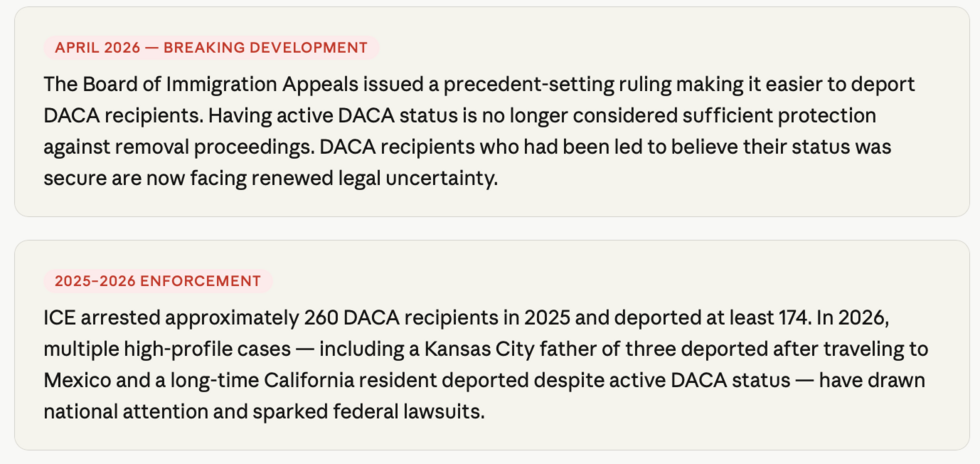
DACA renewals are also experiencing processing delays of five months or more. If a work permit expires while the renewal is pending, there is currently no grace period — recipients immediately lose their authorization to work. This is creating real financial hardship for people who have done everything right.
DACA still exists and USCIS is still accepting renewals as of May 2026. But it is no longer a reliable shield against deportation. Every DACA recipient should consult with an immigration attorney about their specific situation — particularly before traveling internationally.
Key DACA risks to know right now
- Traveling outside the U.S. — even briefly — can trigger reinstatement of old removal orders
- Processing delays may leave you without work authorization for months
- The April 2026 BIA ruling means DACA status alone may not stop deportation proceedings
- Some states have removed DACA recipients from Affordable Care Act coverage and in-state tuition eligibility
- DHS has publicly urged some recipients to "self-deport"
Unique challenges Mexican immigrants face in the U.S.
Mexican immigration has always been political — swinging from open-door policies during labor shortages to aggressive restriction campaigns during periods of economic anxiety. What makes today different is the speed at which enforcement priorities have shifted, and the degree to which legal status that seemed solid is now being challenged.
Beyond the legal complexity, Mexican immigrants navigate stereotypes, language barriers, and — in many communities — a culture of fear that makes people reluctant to seek the legal help they're entitled to. That silence is understandable, but it often makes situations worse. An attorney can assess your actual risk, not just the fear.
"The biggest mistake I see is people waiting. They think if they stay quiet and keep their heads down, the issue will resolve itself. In immigration law, delays almost always narrow your options — not expand them."
Common legal situations Mexican clients face
- DACA renewals, delays, and deportation defense
- Family-based visa petitions and reunification
- Work visa applications and employment authorization
- Removal and deportation proceedings
- Adjustment of status from undocumented to lawful permanent resident
- Challenges related to prior removal orders discovered at ports of entry
- Asylum claims based on violence or persecution
The contributions Mexicans make to the United States
It's easy for immigration debates to reduce people to political abstractions. The reality is that Mexican-Americans and Mexican immigrants are woven into the fabric of American life in ways that statistics can only partially capture.
Mexican immigrants and their descendants work in agriculture, construction, healthcare, education, hospitality, and technology. They start businesses. They serve in the military. They pay taxes, raise families, and contribute to communities across every state in the country. The cultural contributions — in food, art, music, language, and tradition — have shaped American identity in lasting ways.
Immigrants from Mexico represent the largest single group of foreign-born residents in the United States. Their economic and cultural contributions are not incidental — they are structural. The U.S. economy in agriculture, construction, and service industries depends in significant part on Mexican labor and entrepreneurship.
None of this makes navigating U.S. immigration law easier. But it is worth saying plainly: the people we represent are not a burden or a threat. They are neighbors, workers, parents, and community members who deserve to have their legal rights protected just like anyone else.
Visa options and what to know before you apply
Depending on your situation, there may be multiple legal pathways available to you. The challenge is that the right option depends heavily on your specific circumstances — your family ties, your employment, your history with U.S. immigration authorities, and the current state of the law.
Common visa pathways for Mexican nationals
- Family-based visas — if you have a U.S. citizen or lawful permanent resident spouse, parent, child, or sibling who can petition for you
- Employment-based visas — through a U.S. employer who sponsors your application
- TN visas — available specifically to Mexican and Canadian professionals under the USMCA trade agreement
- U visas — for crime victims who have suffered abuse and cooperated with law enforcement
- Asylum — for individuals who face persecution based on race, religion, nationality, political opinion, or membership in a particular social group
- Adjustment of status — a process to become a lawful permanent resident while remaining in the U.S.
Each of these pathways has specific eligibility requirements, documentation demands, and deadlines. A single error or omission in an application can result in delay, denial, or worse — triggering removal proceedings. Having an attorney prepare and review your application is not a luxury. In 2026, it is a necessity.
How Richa Malik helps Mexican clients specifically
Attorney Richa Malik built her practice around the belief that every client deserves to understand exactly what is happening in their case — not just receive instructions to sign documents. That philosophy matters especially for Mexican clients navigating a system that can feel overwhelming, confusing, and hostile all at once.
Richa is learning Spanish specifically to serve her Mexican clients better. Language barriers in immigration proceedings can be costly — misunderstood questions, incorrectly completed forms, and missed deadlines all happen when clients don't fully understand the process. Her goal is to make sure that never happens to you.
What working with Richa Malik looks like
- Every step of your legal process explained clearly — in plain language, not legal jargon
- Visa applications prepared completely and accurately to give you the strongest possible chance
- Proactive communication so you're never left wondering what's happening with your case
- Spanish language support to eliminate communication barriers
- Representation grounded in knowledge of the specific challenges Mexican clients face
- Honest guidance about your options — no false promises, no vague reassurances
Knowledge is power in immigration proceedings. Richa Malik's commitment is to make sure you have the knowledge you need to make confident, informed decisions at every stage of your case — not to simply tell you what to do.

Frequently asked questions — Mexican immigration 2026
- Is DACA still valid in 2026?
- Can a DACA recipient be deported in 2026?
- What should I do if ICE contacts me or comes to my home?
- What is a TN visa and can Mexican nationals use it?
- What is a TN visa and can Mexican nationals use it?
Yes. The TN visa is a work visa available specifically to citizens of Mexico and Canada under the United States-Mexico-Canada Agreement (USMCA). It allows professionals in specific designated occupations — including engineers, accountants, scientists, lawyers, and many others — to work in the United States for a U.S. employer. TN visas are renewable and can be a practical option for qualified professionals. An immigration attorney can help you determine if your occupation qualifies and prepare a strong application.
- Does Malik Law Firm provide services in Spanish?
- What is the difference between a removal order and a deportation order?
Tags
MEXICAN IMMIGRATION ATTORNEY DACA 2026 IMMIGRATION LAWYER FOR MEXICANS TN VISA MEXI CODE PORTATION DEFENSE ATTORNEY FAMILY VISA PETITION DACA DEPORTATION 2026 RICHA MALIK IMMIGRATION ATTORNEY WORK VISA FOR MEXICAN NATIONALS IMMIGRATION HELP SPANISH SPEAKING ATTORNEY REMOVAL ORDER DEFENSE MEXICAN IMMIGRANT RIGHT SICE ARREST DACA 2026 ADJUSTMENT OF STATUS ATTORNEY MALIK LAW FIRM IMMIGRATION