
Planning Ahead: Why a Will or Trust Could Be the Most Important Legal Step You Ever Take
Nobody likes thinking about what happens after they're gone. It's uncomfortable, it feels distant, and most people convince themselves they'll "get around to it eventually." But estate planning attorneys hear the same story over and over — families left scrambling, courts deciding who gets what, and months of stress that a simple document could have prevented. Here's what you actually need to know.
What estate planning actually means (and doesn't mean)
Let's clear something up first. A lot of people hear "estate planning" and picture wealthy families with mansions and investment portfolios managed by a team of lawyers. That image has kept an enormous number of ordinary people from doing something that would genuinely protect them.
Estate planning simply means deciding — in advance, legally, in writing — what happens to your belongings, your financial accounts, your home, and in some cases your children, when you pass away or become incapacitated. It's not about wealth. It's about clarity and control.
Without a documented estate plan, state law makes decisions for your family. Courts, not you, may determine who raises your children, who manages your accounts, and who inherits your home. Estate planning is how you keep that control where it belongs — with you.
At Malik Law Firm, we work with first-time homeowners, young parents, small business owners, and retirees — not just the wealthy. Because anyone who has people they care about and things they've worked for has a reason to plan ahead.
The Last Will and Testament — how it works and what it covers
A will is probably the most well-known estate planning document, but it's also one of the most misunderstood. People assume that having one means their wishes will automatically be honored without any legal process. That's not quite accurate — but a properly drafted will still makes an enormous difference.
Think of a will as an instruction manual left behind for the people and institutions that will handle your affairs. It tells everyone who gets what, who's in charge of making sure that happens, and — critically — who you want to care for your minor children if something happens to both parents.
What a properly prepared will can do for your family
- Name exactly who inherits your assets — home, accounts, personal property
- Appoint a guardian for minor children — one of the most important decisions a parent can make
- Designate an executor who manages your estate through the legal process
- Reduce the chance of family disputes over your belongings
- Simplify and speed up the probate process for your loved ones
A will does go through probate — the court-supervised process of validating your wishes and distributing assets. This process is public, can take months, and adds cost. For many families, that's manageable. For others, a trust is a better solution. More on that below.
One thing that surprises people: a will only controls assets that are in your name alone. Retirement accounts, life insurance, and jointly held property pass outside of your will entirely — they're governed by beneficiary designations and title arrangements. A complete estate plan takes all of this into account.
Trusts — who they're for and why more people need them
If a will is an instruction manual, a trust is more like a legal container. It holds assets during your lifetime and distributes them according to your specific terms — often without any court involvement. That distinction matters more than most people realize.
The privacy benefit alone catches many clients off guard. When a will goes through probate, it becomes part of the public record. Anyone can look it up. A trust, by contrast, is entirely private. Your family's financial affairs stay between your family and the people you've chosen to manage the process.
What trust planning makes possible
- Avoid probate entirely — assets transfer directly to beneficiaries
- Control exactly when and how beneficiaries receive their inheritance
- Protect assets for a child who is a minor, or has special needs
- Continue managing your affairs if you become incapacitated before death
- Protect assets from creditors or a beneficiary's poor financial decisions
- Create a clear plan for long-term care needs
Types of trusts Malik Law Firm assists with
Trusts are not just for the wealthy. Any family with minor children, real estate, a blended household, or a beneficiary with special needs has strong reasons to consider a trust as the foundation of their estate plan.
Will vs. Trust — which one is right for your situation
This is the question we hear most often. The honest answer is that many clients benefit from both — a trust to handle major assets and avoid probate, paired with a "pour-over will" that captures anything left outside the trust and routes it in. But here's a quick-reference breakdown:
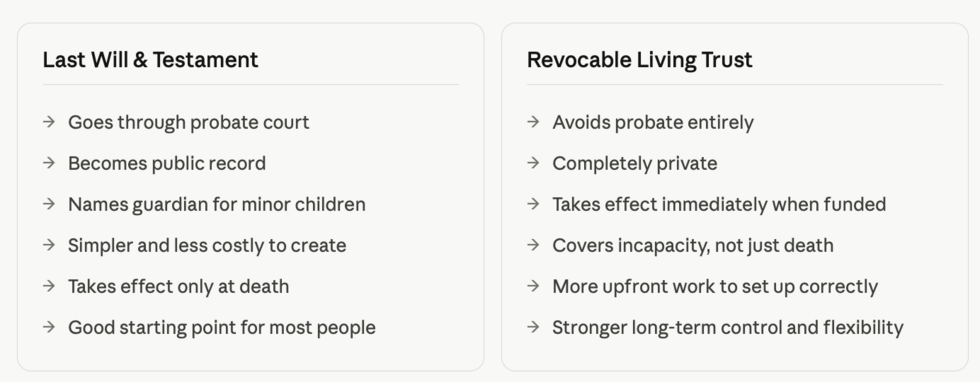
The right choice depends on your assets, your family structure, your state's probate rules, and your long-term goals. That's exactly the kind of conversation we have with clients during a consultation — no one-size-fits-all answers, just a plan built around your actual situation.
What happens if you die without any estate plan
Dying without a will or trust is called dying "intestate." When that happens, your state's intestacy laws take over — and those laws don't know anything about your specific wishes, your family dynamics, or the people who mattered most to you.
"Intestacy laws distribute assets based on legal relationships, not actual ones. Your closest friend of thirty years may receive nothing. A distant relative you haven't spoken to in decades may inherit your home."
Beyond the distribution question, dying without a plan creates real practical hardship for the people you leave behind. Your accounts may be frozen. Your family may need to petition a court just to access basic funds. The process can take a year or longer, and it costs money the estate has to absorb.
If you have minor children and no designated guardian in a valid will, a judge — not you — decides who raises them. That's probably the most compelling reason for young parents to prioritize estate planning above everything else.
Common mistakes that undermine even well-intentioned plans
Over the years we've seen the same avoidable errors come up repeatedly. The good news is that every one of these is preventable with proper legal guidance:
- Creating a trust but never funding it — a trust only controls what's inside it
- Outdated beneficiary designations that contradict the will or trust
- Failing to update documents after marriage, divorce, or the birth of a child
- DIY documents that fail to meet state execution requirements
- No durable power of attorney — leaving no one legally able to act during incapacity
- Assuming joint ownership eliminates the need for a proper estate plan
Estate planning is not a one-time event. It's a living process. A plan created ten years ago may not reflect your current assets, relationships, or intentions. Reviewing your documents every few years — and after any major life event — is part of protecting what you've built.
Ready to protect your family and your future?
At Malik Law Firm, we help individuals and families create estate plans that actually reflect their lives. Whether you need a basic will or a comprehensive trust strategy, we're here to guide you every step of the way.
Frequently asked questions about estate planning
- What is the difference between a will and a living trust?
- How does a trust avoid probate?
When assets are properly titled in the name of your trust (or transferred into it), they are no longer considered part of your individual estate at death. Because they're already owned by the trust, no court process is required to transfer them to your beneficiaries. The trustee simply follows the terms you set when you created the trust. The key word is "properly funded" — a trust that exists on paper but holds no assets won't avoid probate for those unfunded assets.
- Do I really need an estate plan if I don't have a lot of assets?
Yes — and this misconception is one of the most common reasons people delay planning until it's too late. Estate planning is not about how much you own. It's about who makes decisions for you if you can't, who cares for your children, and who receives whatever you do have. Even a modest estate can create serious family conflict or legal complications without a plan in place.
- Can I change my will or trust after it's created?
A revocable living trust can be amended or revoked entirely as long as you are alive and have mental capacity — you retain full control. A will can be updated through an amendment called a codicil, or simply by creating a new will that revokes the prior one. Irrevocable trusts, by their nature, cannot be easily changed — which is why they offer stronger asset protection, but require more careful consideration before establishing.
- Who should I name as executor of my will or trustee of my trust?
- What is a special needs trust and who needs one?
- How often should I review or update my estate plan?
- Does estate planning only matter if I'm older?
Tags
ESTATE PLANNING WILLS AND TRUSTS LAST WILL AND TESTAMENT REVOCABLE LIVING TRUST IRREVOCABLE TRUST SPECIAL NEEDS TRUST AVOID PROBATE ESTATE PLANNING ATTORNEY FAMILY ASSET PROTECTION MALIK LAW FIRM GUARDIAN FOR MINOR CHILDREN ESTATE PLAN WITHOUT PROBATE PLANNING AHEAD EXECUTOR OF WILLINT ESTATE SUCCESSION