
Affirmative vs. Defensive Asylum:
Two Very Different Roads
One path is a conversation with an officer who wants to understand your story. The other is a courtroom, a government prosecutor, and rules of evidence — with deportation on the line if you lose. Knowing which road you're on changes everything.
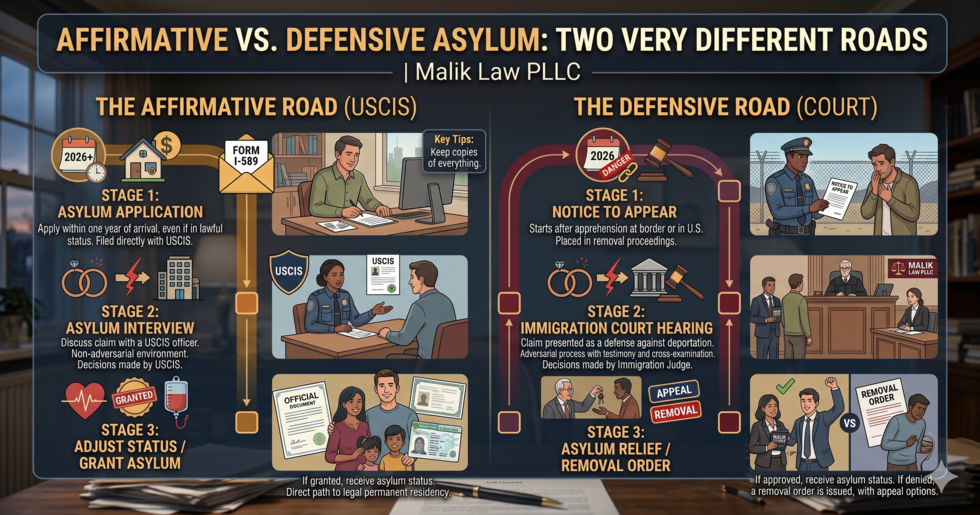
Affirmative asylum is filed proactively with USCIS by someone not in removal proceedings — a non-adversarial interview with an asylum officer, no opposing attorney present. Defensive asylum is raised as a defense against deportation in immigration court under the Executive Office for Immigration Review (EOIR) — a formal adversarial trial with a Department of Homeland Security prosecutor, cross-examination, and rules of evidence. Both paths require proving a well-founded fear of persecution based on one of five protected grounds: race, religion, nationality, political opinion, or membership in a particular social group.
There's a version of this story that plays out quietly, almost gently — someone sits across a table from an asylum officer in a private interview room, tells their story, answers questions, and waits for a decision letter in the mail. And there's another version that plays out in a courtroom, with a government attorney sitting across the aisle, cross-examining every detail of that same story, while a judge in a robe decides whether someone gets to stay in the country or gets ordered removed.
Both of these are "asylum cases." Both rest on the exact same legal foundation: a well-founded fear of persecution. But the experience, the stakes, and the skill required to win are almost nothing alike. Understanding which road your case is on — and why — is the first step toward navigating it successfully.
The Foundation Every Asylum Case Shares
Before getting into the procedural split, it's worth pausing on what doesn't change, no matter which path a case takes. Every valid asylum petition in the United States rests on the same legal standard, found in Section 208 of the Immigration and Nationality Act: proving past persecution or a well-founded fear of future persecution based on one of five explicitly defined protected grounds.
These five grounds are the entire universe of legally cognizable asylum claims in the U.S. It doesn't matter whether your case is heard by a USCIS asylum officer in a quiet interview room or a federal immigration judge in a courtroom — the underlying legal question is identical. What differs dramatically is who decides, how the process unfolds, and what happens if you lose.
The Procedural Split: Two Roads, One Standard
Affirmative Pathway
- A proactive strategy — you voluntarily file for protection from within the U.S.
- Non-adversarial administrative interview with a trained asylum officer
- No opposing government trial attorney present
- Begins with Form I-589, filed within one year of arrival in most cases
- Applicants are rarely detained during this process
- If not approved and no lawful status exists, the case is typically referred to immigration court
Defensive Pathway
- Courtroom deportation defense — asylum is raised as a shield against removal
- Formal trial inside immigration court before a federal immigration judge
- An active Department of Homeland Security prosecuting attorney is present
- Governed by rigid rules of evidence and cross-examination
- Triggered by border detention, unlawful status apprehension, or USCIS referral
- An unfavorable outcome results in a formal order of removal (deportation)
Notice what these two pathways have in common procedurally: almost nothing. One is a conversation. The other is litigation. That difference is exactly why "seasoned courtroom litigation and meticulous record building are strictly non-negotiable" once a case enters the defensive arena — the entire structure of the proceeding changes.
How a Case Moves From One Path to the Other
Here's something many people don't realize until they're living through it: these aren't two separate, isolated systems. They're deeply connected — and the most common outcome of an affirmative asylum filing, historically, has been referral into the defensive system.
An individual not currently in removal proceedings files Form I-589, Application for Asylum and for Withholding of Removal, directly with USCIS. This must generally happen within one year of last arrival in the United States, with limited exceptions.
The applicant attends a biometrics appointment, then a non-adversarial interview with a USCIS asylum officer, who evaluates credibility and whether the claim meets the legal standard for protection.
If the asylum officer is satisfied, asylum is granted. If not — and the applicant has no other lawful immigration status — USCIS will generally issue a Notice to Appear (Form I-862) and refer the case to an immigration judge at EOIR. Historically, referral to EOIR has been the single most common outcome of affirmative applications.
Critically, the immigration judge does not simply review USCIS's decision — they conduct a "de novo" hearing, meaning an entirely new hearing and an independent decision, with no deference to the asylum officer's prior findings. This is the defensive asylum process, now playing out as full courtroom litigation with a DHS attorney present.
There's a second, separate way people enter defensive proceedings entirely: through apprehension. Individuals apprehended at or near the border without proper documentation, or apprehended within the U.S. for unlawful status, who express a fear of returning home, are typically referred for a credible fear screening. If an asylum officer finds that fear credible, the case generally proceeds defensively before an immigration judge.
Side-by-Side: What Actually Changes Between the Two Settings
| Feature | Affirmative (USCIS) | Defensive (EOIR) |
|---|---|---|
|
Decision-Maker |
Asylum Officer |
Immigration Judge |
|
Opposing Attorney Present? |
No |
Yes — DHS trial attorney |
|
Process Type |
Administrative interview |
Formal courtroom trial |
|
Cross-Examination? |
No — conversational interview |
Yes — direct and cross-examination |
|
Rules of Evidence? |
Relaxed administrative standards |
Formal evidentiary rules apply |
|
Risk of Detention |
Rare during processing |
Possible, depending on circumstances |
|
Consequence of Denial |
Often referred to EOIR for a new hearing |
Formal order of removal (deportation) |
|
Appeal Path |
Referral to immigration court |
Board of Immigration Appeals, then federal courts |
Asylum in 2026: A Snapshot of the System
Understanding the scale and pressure on the system helps explain why both speed and skilled representation matter so much:
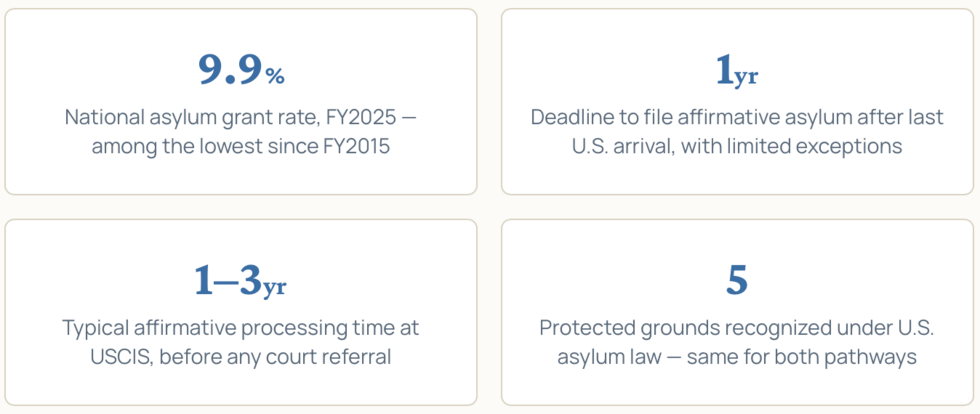
The national asylum grant rate has fluctuated significantly over the past decade — ranging from roughly 9.9% in FY2025 to as high as 20.7% in FY2018 — reflecting shifting agency priorities, caseload pressures, and policy changes across administrations. This volatility underscores why the strength of legal preparation, regardless of which pathway a case is on, matters more than ever.
Why the Defensive Setting Demands a Fundamentally Different Strategy
It would be a mistake to think of defensive asylum as simply "affirmative asylum, but in a different room." The structural differences change what winning actually requires.
An Active Government Adversary
In immigration court, a Department of Homeland Security trial attorney is present specifically to argue against the asylum claim — challenging credibility, raising legal bars to eligibility, and cross-examining the applicant directly. This adversarial dynamic does not exist in the affirmative interview setting, where the asylum officer's role is investigative and evaluative, not prosecutorial.
Formal Rules of Evidence and Procedure
Immigration court proceedings follow structured evidentiary rules, exhibit numbering, witness testimony procedures, and formal objections — much closer to a civil trial than an administrative interview. Meticulous record building, properly authenticated documentary evidence, and well-prepared witness testimony become essential, not optional.
The Direct Consequence of Losing
Perhaps the starkest difference: an unfavorable outcome in defensive proceedings results in a formal order of removal. This is not merely a denial that allows for a do-over — it is the legal mechanism for deportation. The applicant generally remains lawfully in the country while a defensive case is pending, but that protection ends if the case is lost and appeals are exhausted.
Most individuals seeking affirmative asylum must file Form I-589 within one year of their last arrival in the United States, per the Immigration and Nationality Act. Limited exceptions exist for changed or extraordinary circumstances, but late filings face a significantly higher burden. Missing this deadline without understanding the exceptions can foreclose the affirmative pathway entirely, making early legal consultation essential.
Why Representation Changes the Outcome in Both Settings
Whether a case is affirmative or defensive, one truth holds in both: the quality of legal preparation directly affects the outcome. In the affirmative setting, an attorney helps build a credible, well-documented narrative and prepares the applicant for an interview that, while non-adversarial, still requires precision and consistency. Country-condition evidence, corroborating documentation, and a clear legal theory connecting the applicant's experience to one of the five protected grounds all matter enormously — even in a "friendlier" setting.
In the defensive setting, those same elements become courtroom exhibits and testimony, subject to cross-examination by a trained government attorney. The applicant isn't just telling their story — they're defending it under scrutiny, in real time, in front of a judge who has the legal authority to order their removal from the country. There is no substitute, in this setting, for an attorney who has tried cases in immigration court and understands how DHS attorneys typically build their cross-examinations.
Frequently Asked Questions
What is the difference between affirmative and defensive asylum?
Affirmative asylum is filed proactively with USCIS by someone not currently in removal proceedings — a non-adversarial administrative interview with an asylum officer, with no opposing attorney present. Defensive asylum is raised as a defense against deportation in immigration court before an immigration judge with the Executive Office for Immigration Review (EOIR), involving a Department of Homeland Security prosecuting attorney, cross-examination, and formal rules of evidence. The same legal standard — a well-founded fear of persecution based on one of five protected grounds — applies in both settings.
What happens if my affirmative asylum application is denied?
If USCIS does not approve your affirmative asylum application and you do not have other lawful immigration status, USCIS will generally issue a Notice to Appear and refer your case to an immigration judge at EOIR for defensive processing. The immigration judge then conducts a brand-new ("de novo") hearing, completely independent of USCIS's prior decision — meaning you essentially restart your case, now in a formal courtroom setting with a government attorney present.
What are the five protected grounds for asylum?
Under Section 208 of the Immigration and Nationality Act, an asylum applicant must demonstrate past persecution or a well-founded fear of future persecution based on one of five protected grounds: race, religion, nationality, political opinion, or membership in a particular social group. These same five grounds form the legal foundation for both affirmative and defensive asylum claims — the standard does not change based on which pathway a case takes.
How long does the affirmative asylum process take in 2026?
Timelines vary considerably based on USCIS Asylum Office caseload and current processing priorities. Interview scheduling alone can range from a few months to several years. The overall affirmative process — from filing Form I-589 to a final decision — commonly takes one to three years. If a case is subsequently referred to immigration court for defensive proceedings, the additional timeline through master calendar hearings, merits hearings, and potential appeals can add years more, given ongoing nationwide immigration court backlogs.
Is defensive asylum harder to win than affirmative asylum?
Defensive proceedings are structurally more adversarial and demanding — involving a trained DHS trial attorney, cross-examination, and formal evidentiary procedures, with deportation as the direct consequence of an unfavorable ruling. This doesn't automatically mean every defensive case is weaker on the merits, but it does mean the litigation skill, evidentiary preparation, and courtroom experience required to succeed are significantly greater than in the non-adversarial affirmative interview setting.
Do I need a lawyer for an asylum case?
Representation is not legally required, but it has a substantial impact on outcomes in both settings — and especially in defensive proceedings, where applicants face a trained government attorney in a formal courtroom governed by rules of evidence. National immigration court data has consistently shown that represented applicants achieve meaningfully better outcomes than unrepresented applicants. Given the complexity of the legal standard, the one-year filing deadline, and the high stakes of a removal order, consulting an experienced asylum attorney as early as possible is strongly advisable in either pathway.
Whichever Road Your Case Is On, You Shouldn't Walk It Alone.
At Malik Law PLLC, we provide sophisticated, client-centered representation from administrative filings through aggressive courtroom defense. Contact our Pacific Northwest office to structure your immigration path safely.

Comments
There are no comments for this post. Be the first and Add your Comment below.
Leave a Comment