
If you're reading this because you or someone you love is afraid to go home — this guide is for you. Asylum law exists for exactly that reason: to give people who face real persecution a legal path to safety in the United States. But in 2026, that path is harder to navigate than it's ever been. Here's what you actually need to know.
- What asylum actually is — and what it isn't
- The five protected grounds for asylum eligibility
- Affirmative vs. defensive asylum — two very different paths
- The step-by-step asylum application process
- Critical 2026 changes you must know
- What can disqualify you from asylum
- What happens after asylum is granted
- Frequently asked questions
What asylum actually is — and what it isn't
Asylum is one of the oldest principles in international law — the idea that people who face genuine persecution in their home country deserve protection somewhere safe. The United States codified that principle into domestic law, and it remains available today despite the significant political pressure the program faces.
To be eligible for asylum in the United States, you must be physically present in the country or at a port of entry. You must show that you have suffered persecution in the past — or have a well-founded fear of future persecution — on account of a specific protected ground. And in most cases, you must apply within one year of arriving in the United States.

It's also worth being clear about what asylum is not. It is not available simply because life in your home country is difficult, dangerous in a general sense, or economically desperate. The law requires that the harm you fear be connected to one of five specific protected grounds. We'll cover those next.
The five protected grounds for asylum eligibility
U.S. asylum law recognizes five protected grounds. Your fear of persecution must be connected to at least one of them — and that connection must be specific, credible, and documented. Broad claims of general danger, crime, or poverty typically don't meet the legal standard on their own.
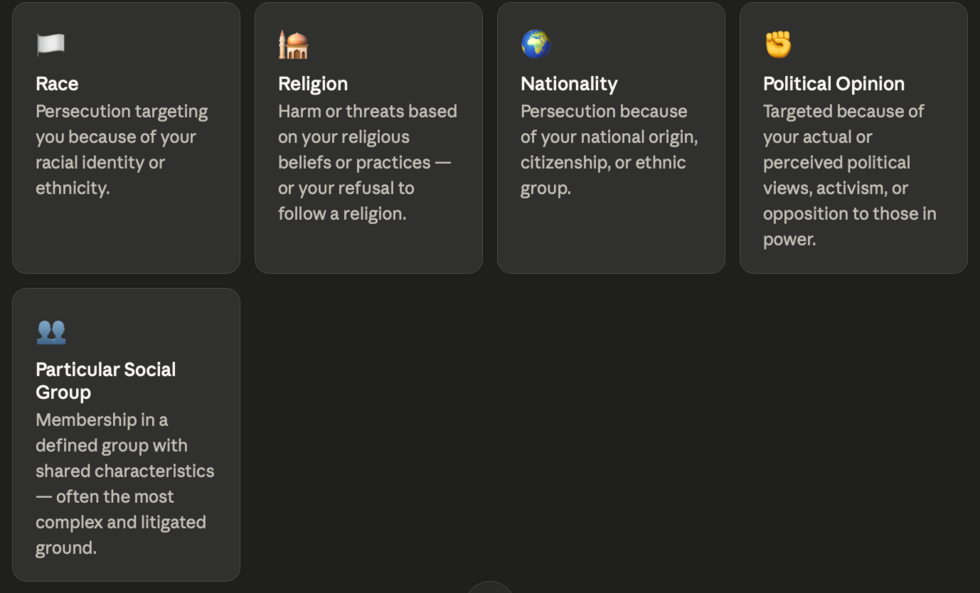
The "particular social group" category deserves extra attention because it's the most commonly used and the most frequently disputed. Courts have recognized various groups under this category — domestic violence survivors, LGBTQ+ individuals, former gang members targeted for refusing to cooperate, and others. But the legal definition is strict: the group must be defined by a characteristic members cannot change, be socially distinct in their country, and be defined with particularity.

Affirmative vs. defensive asylum — two very different paths
One of the most important things to understand about U.S. asylum law is that there are two completely separate processes — and which one applies to you depends on your circumstances at the time you file. Getting this wrong can have serious consequences.
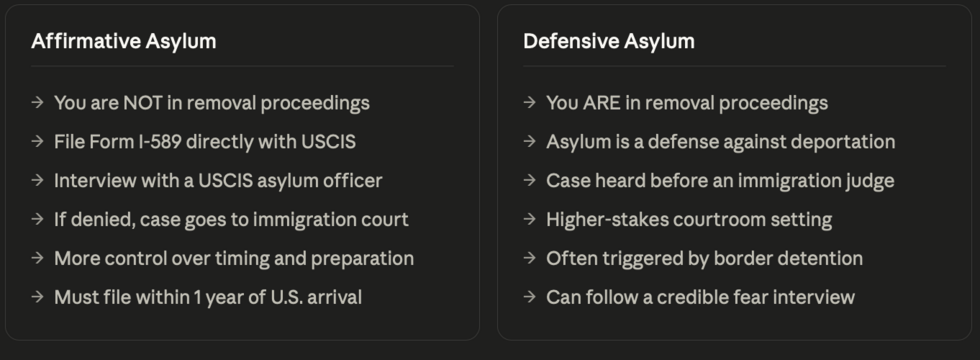
Many people experience both systems. A common path: someone is detained at the border, passes a credible fear interview, and is then placed into immigration court proceedings where they must present their full asylum case before a judge. Each stage requires different preparation, and a mistake at any point can have permanent consequences.
If you pass a credible fear interview, that is not the end of the process — it's the beginning. A positive credible fear determination means the government believes you have a plausible claim. It does not mean asylum has been granted. A full merits hearing before an immigration judge is still required in most cases.
The step-by-step asylum application process
The process looks different depending on whether you're applying affirmatively or defensively, but these are the core stages most applicants move through:
You must apply within one year of your last arrival in the United States. Limited exceptions exist for changed or extraordinary circumstances, but they require compelling evidence. Missing this deadline is one of the most common — and most devastating — mistakes applicants make.
This is the core asylum application. It asks for detailed information about your personal history, your family, and the specific persecution you experienced or fear. Every detail must be accurate and consistent — inconsistencies are among the top reasons asylum claims are denied.
A strong asylum case doesn't rest on your word alone. You'll need a detailed personal declaration, country condition reports from credible human rights organizations, corroborating documents (police reports, medical records, letters from witnesses), and any other evidence that supports your specific claim.
For affirmative cases, a USCIS asylum officer will interview you — asking detailed questions about your claim, your country, and your history. For defensive cases, you'll appear before an immigration judge. In both settings, you can bring an attorney and an interpreter.
If approved, you will be granted asylum status. If denied affirmatively, your case is typically referred to immigration court. If denied by an immigration judge, you have 30 days to appeal to the Board of Immigration Appeals. Missing that deadline is jurisdictional — it forfeits the appeal entirely.
Critical 2026 changes every asylum applicant must know
The asylum landscape in 2026 looks meaningfully different from even two years ago. Several policy and procedural shifts have raised the stakes for applicants at every stage. If you or someone you know is navigating this process, these developments are not optional reading.

Officers in 2026 are applying stricter scrutiny to credibility, consistency, and documentation. There is far less tolerance for delays, administrative errors, or incomplete applications. This is not the environment to navigate without legal representation.
What can disqualify you from asylum
Even a strong claim can be denied if certain bars apply. Understanding these upfront can prevent serious mistakes — including actions that would permanently close off your asylum option.
- Applying more than one year after your most recent arrival in the U.S. (with limited exceptions)
- Persecution of others — if you participated in persecuting others on account of a protected ground
- Conviction of a particularly serious crime, including aggravated felonies
- Posing a danger to U.S. national security or having terrorist connections
- Firm resettlement in another country before arriving in the U.S.
- Generalized danger, poverty, or gang violence not tied to a protected ground
- Being from a country on the administration's restricted list — which in 2026 is treated as a significant negative factor
Even if you are barred from asylum, you may still qualify for withholding of removal or protection under the Convention Against Torture (CAT) — both of which provide legal protection from deportation under different standards. An attorney can assess all available options.
What happens after asylum is granted
Asylum approval is life-changing — but it's not the end of the legal process. Understanding what comes next helps you protect the status you worked so hard to obtain.
- You may live and work legally in the United States indefinitely as an asylee
- You can apply to bring qualifying family members (spouse and unmarried children under 21) to join you via Form I-730
- After one year as an asylee, you may apply for lawful permanent resident status (a green card)
- After five years as a lawful permanent resident, you may be eligible to apply for U.S. citizenship
- You must not return to the country from which you were granted asylum protection — doing so can trigger revocation of your status
- Annual check-ins or re-registration requirements may apply depending on your specific situation

Frequently asked questions — U.S. asylum law 2026
- Who qualifies for asylum in the United States?
- What is the one-year filing deadline for asylum?
- What is a credible fear interview and what happens there?
- What is the difference between affirmative and defensive asylum?
- How long does the asylum process take in 2026?
- Can I work while my asylum case is pending?
- What happens if my asylum application is denied?
- Can I include my family in my asylum application?

Comments
There are no comments for this post. Be the first and Add your Comment below.
Leave a Comment