
The Board of Immigration Appeals has been unusually active in 2026 — and not in ways that comfort most immigrants or their attorneys. From a landmark DACA ruling that sent shockwaves through immigrant communities to sweeping procedural reforms that were partially struck down in federal court, the BIA has been at the center of some of the most consequential immigration decisions in recent memory. Here is everything you need to know — explained plainly, with the facts you actually need.

- What the BIA is and why its decisions matter
- The landmark DACA ruling — Matter of Santiago-Santiago
- The February 2026 Interim Final Rule — what they tried to change
- The March 8 court order — what was blocked and what survived
- BIA statistics in 2026 — a record-breaking year for precedent decisions
- Matter of Orozco Becerra — the in absentia ruling
- What these changes mean for your immigration case
- Frequently asked questions
What the BIA is and why its decisions matter
Most people navigating the U.S. immigration system have heard of immigration courts — the places where judges decide removal cases, asylum claims, and deportation hearings. Fewer people know about the Board of Immigration Appeals, which sits one level above those courts and has enormous influence over how immigration law is applied across the entire country.
The BIA is an administrative appellate tribunal within the Department of Justice. When an immigrant or the government disagrees with an immigration judge's decision, either side can appeal to the BIA. The Board reviews those decisions and — crucially — when it publishes a ruling as a "precedent decision," that ruling becomes binding on all immigration judges nationwide. Every immigration judge in the country must follow it.

The landmark DACA ruling — Matter of Santiago-Santiago (April 24, 2026)
If there is one BIA development from 2026 that every immigrant in the United States needs to understand, it is this one. On April 24, 2026, a three-judge BIA panel issued a precedent decision in Matter of Santiago-Santiago that fundamentally changed how DACA status is treated in removal proceedings.
The case behind the ruling
The decision came out of the case of Catalina "Xóchitl" Santiago, a 28-year-old DACA recipient and immigration rights advocate from Texas. She was detained by Customs and Border Protection officers in August 2025 while boarding a domestic flight in El Paso. She was held in an immigration detention center for approximately two months before a federal judge ordered her release.
Immigration Judge Michael Pleters had terminated her removal proceedings because she held valid DACA status — exactly what judges had been doing for years. DHS appealed that termination to the BIA, and the Board sided with the government. Chief Appellate Immigration Judge Garry D. Malphrus wrote that Judge Pleters had "erred" in terminating proceedings based solely on DACA status, and sent the case to a different judge for fresh review.

What this ruling actually means — and what it doesn't
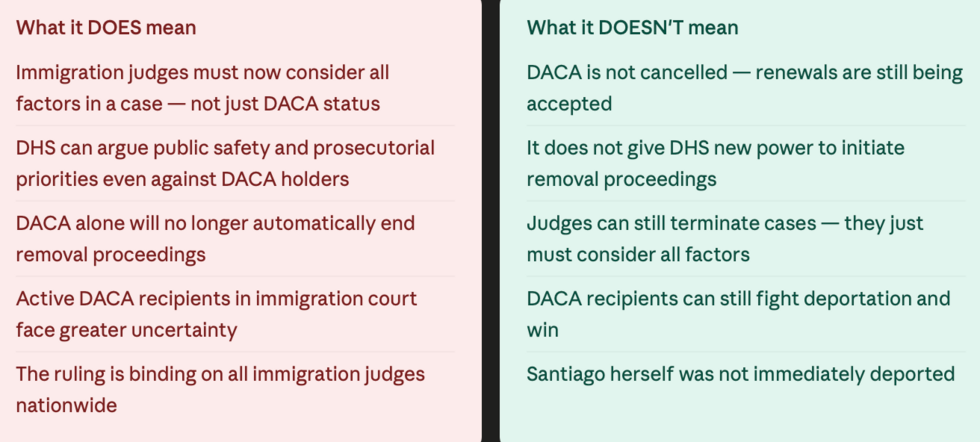
This ruling has been widely mischaracterized in both directions. Some headlines suggested it means DACA is effectively over. That's not accurate. Others dismissed it as a minor procedural adjustment. That's also not right. Here is what the ruling actually does and doesn't do:
"This is a quiet rollback of protections, and our communities are paying the price in real time. For over a decade, DACA has endured relentless, politically motivated attacks. This decision is yet another step in dismantling the program without the government taking responsibility for ending it outright."
— Juliana Macedo do Nascimento, United We Dream

The February 2026 Interim Final Rule — what they tried to change
The DACA ruling wasn't the only seismic BIA development of 2026. On February 6, the Department of Justice published an Interim Final Rule (IFR) that, if fully implemented, would have dramatically restructured how immigration appeals work — in ways that critics argued would effectively eliminate meaningful appellate review for most immigrants.
The rule was framed by the government as a necessary step to address the BIA's enormous backlog. That backlog is real — the Board receives tens of thousands of appeals each year and has struggled for years to keep pace. But the proposed solution alarmed immigration attorneys, civil liberties organizations, and federal judges alike.
What the February IFR proposed
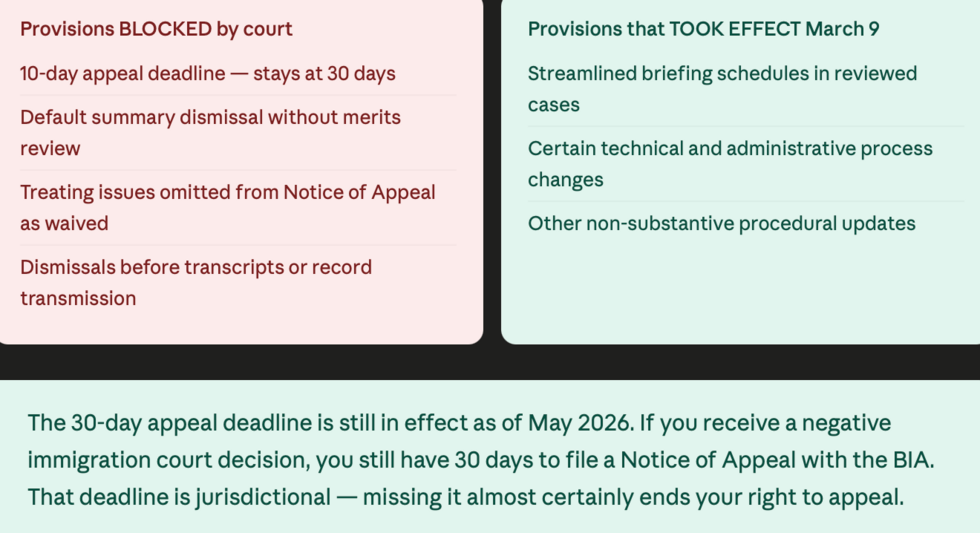
- Shortening the standard appeal deadline from 30 days to just 10 days
- Making merits review discretionary — meaning the BIA could dismiss an appeal without ever reviewing the substance
- Treating any issue not raised in the Notice of Appeal as permanently waived
- Permitting dismissal before transcripts were created or the record transmitted
- Essentially converting the appeal into a rapid screening event rather than a substantive review
As written, the rule would have transformed the Notice of Appeal from a routine jurisdictional filing into a critical legal brief — one that had to identify reversible error with precision and preserve all arguments within 10 days of an immigration judge's decision, often before the applicant even had access to a transcript.
The March 8 court order — what was blocked and what survived
The rule was immediately challenged in federal court by a coalition of immigrant rights organizations including Amica Center for Immigrant Rights, Brooklyn Defender Services, Florence Immigrant & Refugee Rights Project, HIAS, and the National Immigrant Justice Center. The lawsuit argued the IFR violated due process and exceeded the agency's authority.
On March 8, 2026 — the day before the rule was set to take effect — U.S. District Judge Randolph Moss issued an order in Amica Center v. EOIR that blocked several of the most sweeping provisions while allowing others to go forward. The ruling was widely seen as a significant, if partial, victory for immigrants' rights.
he litigation is ongoing. The government may appeal Judge Moss's order, and the underlying rule could be revised and re-issued in modified form. This remains a live and rapidly developing area of immigration law. Anyone with a pending BIA appeal or who anticipates needing to appeal a decision should work with an attorney who is tracking these developments in real time.
BIA by the numbers in 2026 — a record-breaking year for precedent decisions
The volume and direction of BIA decisions in 2025 and 2026 tells a clear story. According to an NPR analysis, the Board ruled in favor of DHS attorneys in 97 percent of publicly posted cases over the past year. That is a significant and striking departure from historical norms.
The Board also published 70 precedent decisions in that period — a record high. Precedent decisions, unlike routine rulings, are binding on every immigration judge in the country. Seventy new binding interpretations of immigration law in a single year represents an extraordinary reshaping of how the system operates at every level.
A 97% DHS win rate at the BIA is not a reflection of case quality alone. When an administrative tribunal's outcomes become this predictable, it raises serious questions about institutional independence — questions that are being actively litigated in federal courts across the country.
Matter of Orozco Becerra — the in absentia removal ruling (May 2026)
Just weeks after the DACA ruling, the BIA issued another significant decision: Matter of Angel Damian Orozco Becerra and Matter of Neythan Orozco Becerra. This one concerned what happens when immigrants repeatedly fail to appear for their removal proceedings.
The practical implication is significant: if you have a removal hearing scheduled, appearing is not optional. Missing even one hearing — for any reason, including fear, confusion, or lack of legal representation — can result in an automatic removal order being entered against you. That order can be extraordinarily difficult to reopen.
If you have a pending removal hearing and are unable to attend for any reason, contact an immigration attorney immediately — before the hearing date, not after. A motion to reschedule or a motion for continuance filed in advance is far easier to win than a motion to reopen after an in absentia order has been entered.
What these changes mean for your immigration case right now
Taken together, the 2026 BIA developments paint a clear picture of the environment every immigrant faces right now: stricter enforcement, less administrative discretion, faster processing with less room for error, and a Board that has aligned closely with DHS enforcement priorities. That doesn't mean the system is closed — it means navigating it requires more preparation, more urgency, and better legal support than ever before.
Immediate action steps depending on your situation
- DACA recipients: Consult an attorney about your specific removal history and whether any prior proceedings create risk under Santiago-Santiago
- Pending BIA appeals: Confirm your filing deadline and ensure your Notice of Appeal is as detailed and legally precise as possible
- Upcoming removal hearings: Appear at every single one — missing a hearing can result in an automatic in absentia order
- Recently denied cases: Calculate your 30-day appeal window from the date of the judge's decision and consult an attorney immediately
- Asylum applicants: The stricter credibility and documentation standards at the BIA level mean your original application must be airtight
- Anyone with old removal orders: Do not travel internationally until an attorney has reviewed whether your travel could trigger reinstatement of that order
2026 BIA developments — full timeline
Frequently asked questions — BIA 2026
- What is the Board of Immigration Appeals and what does it do?
- What did the BIA's DACA ruling in April 2026 actually change?
- Is the 30-day BIA appeal deadline still in effect in 2026?
- What changed about BIA appeals under the February 2026 IFR, and what is still in effect?
- What happens if I miss my immigration court hearing?
- Can the BIA's decisions be appealed further?
- How does the Attorney General's power to review BIA decisions work?
- Should I be worried about my immigration case given the 2026 BIA developments?

Comments
There are no comments for this post. Be the first and Add your Comment below.
Leave a Comment