
F-1 Student? Yes, You Can
Legally Own a Business
You don't have to wait until graduation to start building something real. But on an F-1 visa, the line between "owning" and "working" is the line between a smart move and a status violation — here's exactly where it sits.
Yes, F-1 students can legally own a business in the United States. You may form an LLC, hold shares as a shareholder, and collect profits as a passive investor. What you generally cannot do without separate work authorization is actively work for that business — managing daily operations, finding clients, providing services, or running marketing. The legal line is between ownership (always allowed) and employment (restricted). The major exception: if you're approved for Optional Practical Training (OPT) and your business is directly related to your field of study, you can actively run and work for your own company.
You're sitting in a lecture hall thousands of miles from home, and somewhere between your coursework and your part-time campus job, an idea won't leave you alone. Maybe it's an app. Maybe it's an import business connecting your home country to the U.S. market. Maybe it's something you've been sketching in a notebook for a year. And then the fear creeps in: can I even do this? Will starting a business get me deported?
Here's the relief: the answer isn't no. It's just more nuanced than a yes-or-no question deserves, and the nuance is exactly where people get into trouble. Let's walk through it properly — what the law actually says, where the real risk lives, and how to build something without putting your F-1 status on the line.
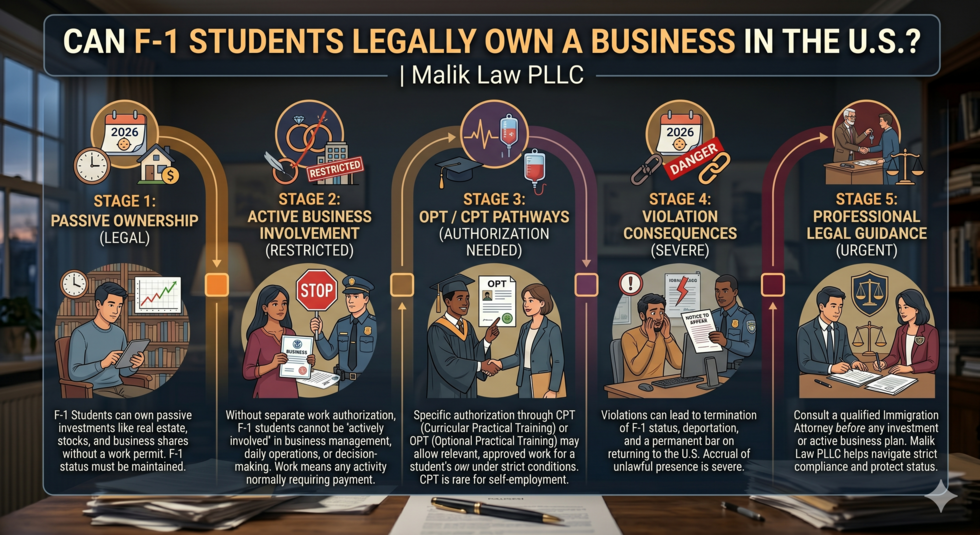
The Core Legal Principle: Ownership ≠ Employment
Everything in this article comes back to one foundational distinction, and once you understand it, the rest falls into place. U.S. immigration law doesn't ask "do you own a business?" It asks "are you working without authorization?"
Those are two completely different questions with two completely different answers for most F-1 students. You can own 100% of a company's shares and never violate your visa status — as long as someone else, properly authorized to work in the U.S., is the one running it day to day.
USCIS defines employment broadly: any service, time, or labor provided to a business in exchange for compensation — even if that compensation is delayed, reinvested, or never actually paid out. This means even unpaid work at your own company can be considered a violation if you lack authorization. It's not about whether money changes hands. It's about whether you're performing the work.
What F-1 Students CAN and CANNOT Do
Here's the practical breakdown — the kind of list you can actually use to evaluate your own situation:
✅You CAN Do This
- Form an LLC or corporation under your own name
- Act as a shareholder or member with an ownership stake
- Invest capital into a startup, including your own
- Receive business profits and distributions
- Sit on a board in a non-operational, advisory capacity
- Hire authorized employees (U.S. citizens, green card holders, or other work-authorized individuals) to run daily operations
- Invest passively in stocks or other ventures
- Attend investor meetings and receive financial reports
🛑You CANNOT Do This
- Actively manage daily business operations
- Find, pitch, or serve clients on the company's behalf
- Negotiate or sign contracts as an active operator
- Run marketing campaigns or manage the company's social media
- Provide direct professional services (coding, design, consulting) for the business
- Make hiring or firing decisions as an active operator
- Take a salary for performing operational work without authorization
- Describe yourself publicly (LinkedIn, company site) as actively running the company without authorization — this is commonly reviewed by consular officers
A Helpful Comparison: Passive Real Estate Investment
If the ownership-versus-employment distinction still feels abstract, real estate investing offers a useful, well-documented parallel that USCIS guidance frequently echoes.
Picture two F-1 students. The first buys a condo, hires a property management company to find tenants, collect rent, and handle repairs, and reports the rental income on their taxes. This is passive investment — the student isn't performing any labor; the property manager is. Fully compliant.
The second student forms an LLC, personally scouts properties, negotiates purchase deals, manages renovations, and coordinates repairs themselves. This is active involvement — and it is considered unauthorized employment, regardless of the LLC structure wrapped around it.
The exact same logic applies to any business: software companies, e-commerce stores, consulting practices, restaurants. The entity structure doesn't determine compliance. The day-to-day reality of who's doing the work does.
The Big Exception: What Changes When You're on OPT
This is the part most students are waiting for. Optional Practical Training (OPT) creates a genuine pathway to actively run your own business — but it comes with real conditions that USCIS and immigration attorneys take very seriously.
If you are approved for OPT (including STEM OPT for eligible degree fields), self-employment is allowed, provided you satisfy three core requirements:
| Requirement | What It Means in Practice |
|---|---|
|
Proper Business Formation |
Your business must be legally registered as an LLC or corporation with the state, have all formation documents (Articles of Incorporation, operating agreement) in order, and obtain an EIN from the IRS. |
|
Active, Substantial Engagement |
You must genuinely and consistently work in the business — generally understood as at least 20 hours per week. Passive ownership alone does NOT satisfy OPT requirements; you must be doing real, documented work. |
|
Direct Relation to Your Degree |
The work you perform must directly relate to your major field of study. A computer science graduate running a software startup qualifies; the same graduate running an unrelated retail business generally does not count toward OPT compliance. |
|
Documentation |
Maintain detailed records: business licenses, contracts, work samples, project files, prototypes, and a written narrative connecting your tasks to your degree program. This evidence matters enormously if your status is ever reviewed. |
A pre-revenue startup can still qualify for OPT compliance — you don't need paying customers yet. What matters is genuine, documented, degree-related engagement, not profitability.
- Assuming any business activity counts toward OPT, regardless of its connection to your major field of study.
- Failing to maintain the SEVIS-required documentation showing genuine, consistent engagement — this stops the 90-day unemployment clock only if conditions are properly met and documented.
- Treating passive ownership as sufficient for OPT reporting purposes — it is not. You must be actively working.
- Not reporting self-employment to your school's international student office (ISSO/OISS) in a timely manner.
- Forgetting that the 90-day unemployment limit during OPT (and 150 days for STEM OPT) still applies — time spent setting up a business without qualifying work can count against this clock.
What About CPT? A Narrower, Riskier Path
Some students ask about using Curricular Practical Training (CPT) to work at their own business instead of waiting for OPT. This route exists in theory, but it is considerably harder to execute compliantly.
CPT generally requires a genuine employer-employee relationship in which the student is supervised by someone else and retains less than 50% control of the business. Self-employment is fundamentally in tension with CPT's supervision requirement — if you control the company, who is supervising you?
This is a structure that requires careful, individualized legal analysis and close coordination with your Designated School Official (DSO) before you proceed. It is not a do-it-yourself decision.
CPT Self-Employment
Requires genuine supervision and under 50% ownership control. Difficult to structure compliantly for a true founder.
Hard / High RiskOPT Self-Employment
Allowed if properly licensed, actively engaged 20+ hrs/week, and work is directly related to your degree field.
Possible With ConditionsPassive Ownership (Any F-1 Status)
Form an LLC, hold shares, collect profits — while authorized staff handle all operations. Always available.
Safest PathStructuring for the Long Game: Protecting Your Visa and Your Future
The way you structure your business today doesn't just protect your F-1 status — it can shape your long-term immigration options. Many international student founders eventually want to transition to a visa that allows full, active involvement in their company. Two common pathways:
The H-1B Pathway
If your company grows and becomes financially viable, it may eventually be able to sponsor you for H-1B status as an employee — though self-sponsorship through your own company involves additional scrutiny from USCIS regarding the legitimacy of the employer-employee relationship. Careful corporate structuring (an independent board, other investors, clear organizational control) strengthens this case considerably.
The E-2 Treaty Investor Pathway
If you are a national of a country with a qualifying E-2 treaty with the United States, and you make a substantial investment in a U.S. business, the E-2 visa can allow you to actively direct and develop that enterprise. This is often a natural next step for student founders whose passive ownership structure has proven the business concept and generated real capital.
The decisions you make now — how you incorporate, who you bring on as authorized operators, how clearly you document the separation between your ownership and any operational involvement — directly affect how smoothly these future transitions go.
Why "Just Being Careful" Isn't Enough
Here's something that surprises a lot of student founders: consular officers and USCIS don't just take your word for how involved you are in a business. They actively look.
Visa applications now routinely request social media handles. Consular officers review company websites, incorporation documents, LinkedIn profiles, and even press coverage when assessing whether a student's actual involvement matches what's legally permitted. A LinkedIn bio that says "Founder & CEO, running day-to-day operations" can directly contradict a passive-ownership compliance strategy — and create exactly the kind of red flag that leads to denied visa renewals or worse.
This is precisely why structuring your business entity properly from day one matters so much. It's not just about avoiding violations today — it's about building a documented, defensible record that protects every future interaction you have with immigration authorities: visa renewals, OPT applications, future H-1B sponsorship, and eventually, a green card.
Frequently Asked Questions
Can F-1 students legally own an LLC in the U.S.?
Yes. F-1 students may legally form and own an LLC, including a single-member LLC, in any state. The LLC can be registered with an EIN under the student's name. What matters for visa compliance is not the ownership structure itself, but whether the student is performing active operational work without proper authorization. Many F-1 students structure their LLCs as manager-managed, with an authorized individual (such as a U.S. citizen co-founder or hired manager) handling all day-to-day decisions.
What exactly counts as "unauthorized employment" for an F-1 student business owner?
Unauthorized employment includes any service, labor, or operational involvement provided to the business without proper work authorization — regardless of whether you're paid. This includes managing daily operations, finding or serving clients, negotiating or signing contracts, running marketing or social media campaigns, making hiring decisions, and providing direct professional services (like coding, design, or consulting) for the company. USCIS defines employment broadly, and the absence of a salary does not exempt these activities from being considered unauthorized work.
Can F-1 students work for their own startup while on OPT?
Yes, with conditions. Self-employment is permitted on OPT (including STEM OPT) if: (1) the business is properly licensed and formed as a legitimate entity such as an LLC or corporation with an EIN, (2) you are actively and substantially engaged — generally at least 20 hours per week — in real, documented work, and (3) that work is directly related to your major field of study. Passive ownership alone does not satisfy OPT's self-employment requirements; you must be genuinely performing degree-related work and keeping detailed records to prove it.
Can F-1 students use CPT to work at their own company?
It's very difficult and high-risk. CPT generally requires a genuine employer-employee relationship where the student is supervised by someone else and holds less than 50% ownership control of the business. True founders who control their company typically cannot satisfy CPT's supervision requirement. Anyone considering this path should consult their Designated School Official (DSO) and an immigration attorney before taking any action, as the analysis is highly fact-specific.
What happens if I violate F-1 work authorization rules through my business?
The consequences can be severe and long-lasting. Unauthorized employment can result in termination of your SEVIS record and loss of F-1 status, often with limited options to remedy the violation while in the U.S. Beyond the immediate impact, a record of unauthorized employment can complicate or jeopardize future immigration benefits — including OPT extensions, STEM OPT eligibility, H-1B sponsorship, and green card applications down the road. Immigration officers routinely review business records, websites, and social media when assessing compliance, so violations are often discoverable even years later.
How should I structure my business to stay compliant from day one?
The safest structure for F-1 students who are not yet on OPT is a manager-managed LLC or corporation where you hold equity as a passive owner while an authorized individual — a U.S. citizen co-founder, green card holder, or properly work-authorized employee — handles all day-to-day operations, client relationships, and contract signing. Documentation matters enormously: clear operating agreements, board resolutions, and a consistent public-facing description of your role (investor/shareholder, not operator) all help build a defensible compliance record. An immigration attorney can review your specific business plan and structure it correctly before you incorporate — which is far easier than fixing a compliance problem after the fact.
Build Your Business Without Risking Your Status.
Structuring your business entity properly from day one is critical — both to keep your visa safe and to pave the way for future long-term pathways like H-1B or E-2. Don't navigate these compliance boundaries alone. Let our team at Malik Law PLLC make sure your student startup is 100% compliant.

Comments
There are no comments for this post. Be the first and Add your Comment below.
Leave a Comment