
Exploring the Special Immigrant Category
The EB-4 Visa (Employment-Based, Fourth Preference) is a U.S. immigrant visa that grants lawful permanent residency — a Green Card — to "special immigrants." Qualifying categories include religious workers (ministers, priests, and religious vocation workers), Special Immigrant Juveniles (SIJ), certain broadcasters, qualifying former U.S. government employees abroad, and eligible international organization workers. Unlike most employment-based visas, EB-4 is rooted in humanitarian, community, and service values rather than corporate employment.
When people think of employment-based Green Cards, the mind usually leaps to tech layoffs, corporate sponsorships, or million-dollar investor visas. But U.S. immigration law preserves a quieter, profoundly important pathway for the people who hold communities together — religious leaders, vulnerable children, public servants, and media professionals. That pathway is the EB-4 Visa.
This guide breaks down everything you need to know about the EB-4: who qualifies, how it works, what advantages it offers, and why professional legal support is not optional for most applicants.
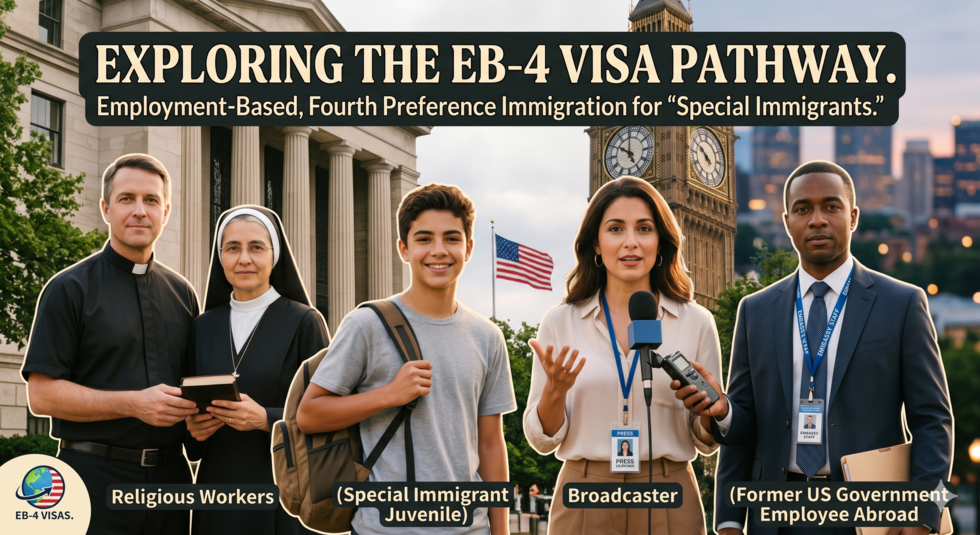
I. Understanding the EB-4 Visa: The Legal Foundation
The EB-4 is the fourth preference employment-based immigrant visa established under the U.S. Immigration and Nationality Act (INA). Congress created it to recognize a class of noncitizens who provide unique, often irreplaceable value to American communities but who do not fit neatly into standard corporate or investor-based visa categories.
Unlike the EB-1, EB-2, or EB-3 categories, which are generally tied to commercial employment or labor certification, EB-4 focuses on service, community welfare, and humanitarian purpose. USCIS reserves up to 7.1% of the annual employment-based Green Card allocation (approximately 9,940 visas per fiscal year) for EB-4 applicants worldwide.
Importantly, the EB-4 is a permanent residency pathway — not a temporary visa. Approved applicants and their immediate qualifying family members receive Green Cards that grant indefinite authorization to live and work in the United States.
II. EB-4 Visa Categories: Who Qualifies?
The EB-4 umbrella covers several distinct sub-categories. Each has its own eligibility rules, sponsorship requirements, and USCIS petition forms. Here is a comprehensive breakdown:
Religious Workers
Ministers, as well as individuals working in a religious vocation or occupation at a qualifying U.S. nonprofit religious organization. The applicant must have been a member of the religious denomination for at least two years immediately prior to filing.
Form I-360 · Non-profit sponsor requiredSpecial Immigrant Juveniles (SIJ)
Children physically present in the U.S. who have been declared dependent on a juvenile court or placed under the custody of a state agency or individual. The child must have been deemed unable to reunify with one or both parents due to abuse, neglect, or abandonment.
Self-petition · Juvenile court order requiredBroadcasters
Media professionals employed in the United States by the International Broadcasting Bureau of the Broadcasting Board of Governors, or by a grantee of the Broadcasting Board of Governors. This category covers a narrow subset of public-interest media roles.
Employer-sponsored · U.S. government entityCertain Former U.S. Government Employees Abroad
Foreign nationals who provided faithful service to the U.S. government abroad (e.g., translators, mission-critical staff at U.S. embassies) and who face, or faced, serious threats as a result of that service. Must have a recommendation from a federal agency head.
Agency recommendation requiredInternational Organization Workers (G-4 / NATO-6)
Former long-term employees of qualifying international organizations (G-4 visa holders) or NATO civilian employees (NATO-6 visa holders), and their immediate family members, who seek to remain in the United States after their employment concludes.
Long-term employment proof requiredOther USCIS-Designated Special Immigrants
USCIS periodically designates additional groups by statute, including certain Panama Canal Zone employees, physicians who practiced medicine in underserved areas under certain waiver programs, and other historically recognized special immigrant classifications.
Category-specific documentationIII. Strategic Advantages of the EB-4 Visa
The EB-4 pathway is often underutilized simply because it is less well-known than other employment-based categories. For those who qualify, it offers distinct structural advantages:
-
Direct Path to Permanent Residency The EB-4 is an immigrant visa, meaning approval leads directly to a Green Card. There is no intermediate nonimmigrant stage or employer-tied temporary status to maintain. You and your eligible family members (spouse and unmarried children under 21) receive lawful permanent resident status.
-
Humanitarian and Community Focus EB-4 was explicitly designed to recognize individuals whose work sustains the social, spiritual, and cultural fabric of American communities. This philosophical alignment means the category is structurally supportive rather than purely market-driven.
-
Elimination of Nonimmigrant Visa Renewal Stress Holders of temporary visas like R-1 (religious worker) or J-1 must manage periodic renewals, employer dependency, and potential status gaps. Obtaining an EB-4-based Green Card ends that cycle permanently, offering stability for multi-year ministry, educational, or family planning.
-
Family Inclusion Derivative beneficiaries — your spouse and unmarried children under 21 — can be included in the same EB-4 petition or a concurrent adjustment of status application. They receive Green Cards with work and travel authorization of their own.
-
Freedom of Movement and Employment Unlike work-specific nonimmigrant visas (H-1B, L-1), a Green Card is not tied to any single employer after approval. Once permanent residency is granted, you may work for any U.S. employer, travel freely, and reside anywhere in the country.
-
Citizenship Eligibility EB-4 Green Card holders become eligible to apply for U.S. naturalization after meeting the five-year continuous permanent residence requirement (or three years if married to a U.S. citizen), opening the full range of civic rights and protections.
IV. The EB-4 Application Process: Step by Step
While the exact process varies by sub-category, the general EB-4 pathway follows these core stages:
-
Confirm Eligibility & Sub-Category
Identify which EB-4 sub-category applies to you and confirm you meet its specific statutory requirements. This is the stage where legal counsel adds the most immediate value — misidentifying your category wastes months and filing fees.
-
Obtain Sponsorship or Qualifying Court Order
Most categories require a qualifying U.S. sponsor (a nonprofit religious organization with IRS tax-exempt status, a U.S. government agency, or a qualifying international organization). SIJ applicants instead need a state juvenile court order.
-
File Form I-360 with USCIS
The Petition for Amerasian, Widow(er), or Special Immigrant (Form I-360) is the primary EB-4 petition. It must be accompanied by comprehensive supporting documentation proving eligibility in your specific category.
-
Monitor the Visa Bulletin
Once I-360 is approved, check the U.S. Department of State's monthly Visa Bulletin. If your country of birth has a backlogged EB-4 priority date, you must wait until a visa number becomes available before proceeding.
-
Adjust Status (Form I-485) or Consular Processing
Once a visa number is available: if you are already lawfully present in the U.S., file Form I-485 (Adjustment of Status). If abroad, proceed through a U.S. embassy or consulate (consular processing via Form DS-260).
-
Biometrics, Interview, and Approval
Attend USCIS biometrics and, if required, an in-person interview. Upon approval, you and qualifying family members receive Green Cards granting lawful permanent residency.
V. EB-4 vs. Comparable Visa Categories
Understanding where EB-4 sits relative to other pathways helps illustrate why it is the right choice for qualifying special immigrants:
| Visa Category | Permanent Residency? | Employer Tied? | Labor Certification (PERM)? | Ideal For |
|---|---|---|---|---|
|
EB-4 (Special Immigrant) |
Yes | No (after approval) | Not required |
Religious workers, SIJ, broadcasters |
|
R-1 Religious Worker (Nonimmigrant) |
No | Yes | Not required |
Temporary religious work |
|
EB-2 / EB-3 (Employment-Based) |
Yes | Yes (during process) | Usually required |
Corporate workers, skilled professionals |
|
EB-5 (Investor Visa) |
Yes | No | Not required |
High-net-worth investors ($800K+) |
|
Asylum / Refugee |
Eventual | No | Not required |
Persecution-based protection |
VI. Critical Considerations Before You Apply
The EB-4 category carries significant potential — but it is also among the most documentation-intensive visa pathways in U.S. immigration. USCIS scrutinizes EB-4 petitions carefully. Common pitfalls include:
- Strict Membership Duration: Religious worker applicants must demonstrate continuous membership in the sponsoring denomination for at least two years prior to filing. Gaps in membership records are a frequent cause of Request for Evidence (RFE) notices.
- Nonprofit Verification: The sponsoring religious organization must hold val id IRS 501(c)(3) or equivalent tax-exempt status. USCIS requires documentary proof — not just the organization's self-attestation.
- Compensation Documentation: You must demonstrate the ability to be "self-supporting" (religious workers) — meaning the organization can financially sustain the position. Weak financial records are a common ground for denial.
- SIJ Timing Sensitivity: Special Immigrant Juvenile petitions must be filed before the child turns 21. Age-out risks require careful, early legal planning.
- Visa Retrogression Risk: For nationals of countries like India, China, Mexico, and the Philippines, EB-4 priority dates can retrogress. Filing timing and Visa Bulletin monitoring are critical strategic decisions.
- Concurrent Filing Strategy: In some cases, the I-360 and I-485 (Adjustment of Status) may be filed concurrently if a visa number is immediately available, saving processing time. Determining eligibility for concurrent filing requires legal analysis.
VII. EB-4 Religious Worker Visas: A Closer Look
Because religious worker petitions represent the largest and most frequently filed EB-4 sub-category, a deeper understanding is essential for churches, mosques, synagogues, temples, and other faith communities across the United States.
Who counts as a "religious worker" under EB-4?
USCIS divides qualifying religious workers into two groups:
1. Ministers: Individuals formally authorized to conduct religious worship and perform other duties usually performed by clergy. A minister must be authorized by the religious denomination — ordination records and letters from denominational leadership are required.
2. Workers in a Religious Vocation or Occupation: Individuals whose traditional calling is the religious life — such as monks, nuns, and religious brothers and sisters — and individuals who work in occupations that are religious in nature (e.g., religious instructors, cantors, liturgical directors). These workers must show the role is a primarily religious function, not merely incidental religious content in a secular job.
What qualifies as a "bona fide nonprofit religious organization"?
The sponsoring organization must be either: (a) a tax-exempt nonprofit religious organization, or (b) a religious organization that has a group tax exemption. USCIS scrutinizes sponsors closely — financial statements, organizational bylaws, proof of active worship services, and documentation of the paid or volunteer congregation are all relevant.
VIII. Frequently Asked Questions About the EB-4 Visa
What is the difference between an EB-4 Visa and an R-1 Visa?
The R-1 is a nonimmigrant (temporary) visa for religious workers, valid for up to 5 years. It does not lead directly to permanent residency and requires continuous employment at the sponsoring organization. The EB-4 religious worker category, by contrast, is an immigrant visa — it leads directly to a Green Card, and once approved, the holder is no longer tied to the sponsoring employer. Many R-1 holders transition to EB-4 as their long-term goal.
Can I self-petition for an EB-4 Visa?
It depends on your category. Special Immigrant Juveniles self-petition — they file their own I-360 based on a juvenile court order, without an employer or organization sponsor. Most other EB-4 categories (religious workers, certain broadcasters, government employees) require a qualified sponsoring organization or agency. You cannot self-petition as a religious worker simply because you are a member of a religious community; there must be a formal sponsoring nonprofit religious organization involved.
How long does EB-4 processing take?
USCIS Form I-360 processing times for EB-4 currently range from approximately 6 to 18 months depending on workload, category, and whether a Request for Evidence (RFE) is issued. Additional time is needed for Adjustment of Status (I-485) or consular processing if priority dates are current. For countries with high EB-4 demand, retrogressed Visa Bulletin priority dates can add months or years to the total timeline. Always check the current USCIS processing times at uscis.gov and the monthly Visa Bulletin at travel.state.gov.
Can my family members get Green Cards through my EB-4 petition?
Yes. Your spouse and unmarried children under 21 years of age are eligible as derivative beneficiaries on your EB-4 petition. They do not need to meet the EB-4 eligibility requirements themselves. They will be included in the Adjustment of Status or consular processing and will receive their own Green Cards upon approval.
Is the EB-4 religious worker category permanent or temporary?
The EB-4 religious worker sub-category has historically required periodic Congressional reauthorization. As of the date of this article, the religious worker provision is active. However, there have been periods in the past where it lapsed temporarily. This is another reason why timely filing — rather than waiting — is strategically important. Your immigration attorney should monitor Congressional actions that could affect this sub-category.
What happens if my EB-4 petition receives a Request for Evidence (RFE)?
A Request for Evidence (RFE) means USCIS needs more information before making a decision — it is not a denial. You will have a specified period (typically 87 days for most petitions) to submit a comprehensive response with additional documentation. RFE responses for EB-4 petitions are highly technical and benefit greatly from legal representation. An inadequate response is a common cause of denial when applicants respond pro se (without an attorney).
Does the EB-4 Visa require a labor market test (PERM)?
No. Unlike the EB-2 and EB-3 categories, which typically require Labor Condition Application or PERM labor certification from the U.S. Department of Labor, the EB-4 category does not require a labor market test. This is a significant advantage — it removes a major processing step and eliminates the risk of labor certification denial.
Ready to Explore Your EB-4 Pathway?
The EB-4 Visa is structurally complex and highly documentation-dependent. A single missing document or incorrect filing can result in delays, RFEs, or denials. At Malik Law PLLC, we map out your application with precision — so your journey to permanent residency stays on track.
Visit: www.maliklawpllc.com · Confidential consultations available

Comments
There are no comments for this post. Be the first and Add your Comment below.
Leave a Comment