
ICE Is Arresting People at
Domestic Airports. Before They Board.
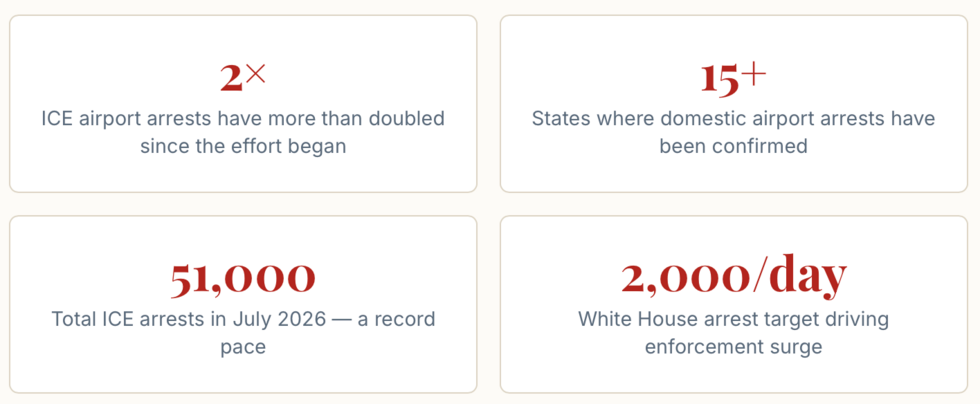
A flight attendant at his Nashville gate. A woman stopping to attend her father's funeral. A DACA recipient in Boston. These aren't isolated incidents — ICE airport arrests have more than doubled nationwide in August 2026.
Yes — ICE can and is arresting people at domestic U.S. airports in August 2026, including at departure gates before boarding. ICE has more than doubled airport arrests since the effort began, using TSA passenger manifest data to locate noncitizens. People being arrested include those with pending green card applications, valid EADs, pending asylum cases, and even DACA status. Arrests have been confirmed at airports in at least 15 states, including LAX, SFO, Denver, Nashville, Houston, and Boston. If you do not have current, valid immigration status and need to fly domestically, consult an immigration attorney before your trip.
For years, there was an unspoken understanding in immigrant communities: airports were for international enforcement, not domestic. If you were boarding a flight from Los Angeles to Dallas, from Chicago to Atlanta, you weren't expecting to be met at the gate by immigration agents. That understanding — fragile as it always was — is no longer safe to rely on.
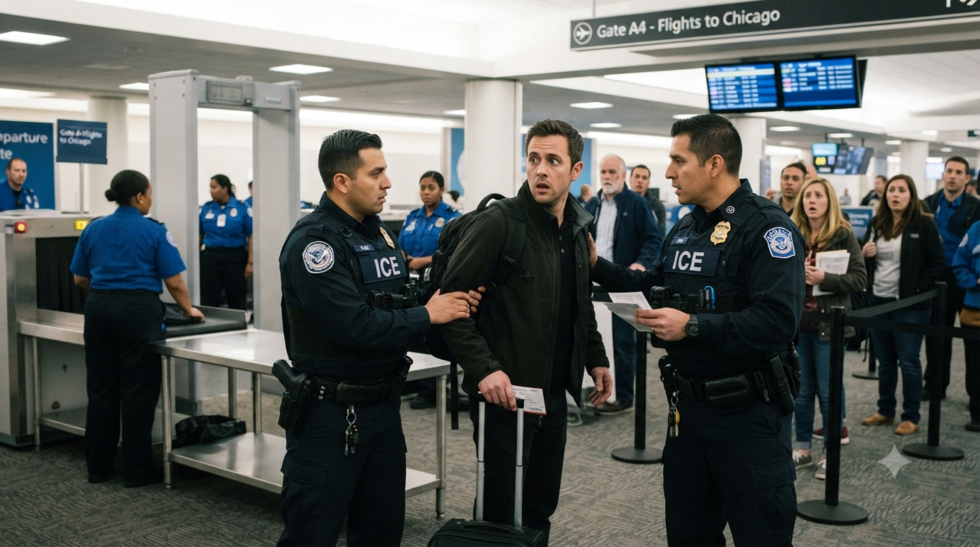
In July and August 2026, ICE agents have been documented arresting noncitizens at departure gates, baggage claims, and security checkpoints across the country — in plain clothes, often without warning, using airline passenger data to identify who is boarding. People with pending immigration cases. People with valid work authorization. People who were, by every measure, following the law.
This Is Not Abstract: Real Cases, Real People
These are not hypotheticals. These are people whose names have been reported in the national press in the past several weeks:
Southwest Flight Attendant Arrested at His Gate While at Work
Lorenzo Thompson, a Jamaican citizen, was arrested by ICE on July 14 while working his shift at Nashville airport. He held a valid work permit and had a pending asylum case. DHS confirmed the arrest, citing an overstayed original visa.
Woman Stopped on the Way to Her Father's Funeral
An immigrant woman was detained at a D.C.-area airport while attempting to fly home to Texas to attend her father's funeral. Her attorney described her as law-abiding with no removal order.
Ecuadorian Au Pair Ambushed at Boarding Gate
Chantal Morales Rojas of Oakland was taken into custody at Denver while attempting to board a domestic flight. She had an expired J-1 visa but had filed an application to extend her legal stay.
Colombian DACA Recipient Detained
A DACA recipient was detained at Boston Logan while traveling domestically — raising serious questions about the scope of enforcement even against those with active DACA protection.
Russian High School Student Arrested
A Russian high school student was arrested at a Houston airport during domestic travel — one of many cases involving individuals who had no criminal history and were not subject to a removal order.
10 Travelers Arrested in One Week in California
According to CHIRLA attorney Matthew Toyama, 10 travelers were arrested by ICE at California airports within a single week. Individuals were stopped at multiple gates before reaching boarding areas.
Who Is at Risk — and Who May Be Safer
⚠ Higher Risk Groups
- People whose nonimmigrant status has expired, even with a pending renewal or extension
- Individuals with pending I-485 (Adjustment of Status) but no Advance Parole
- People with pending asylum applications (I-589) but no current valid status
- Anyone with a prior removal order, even if a case is pending
- Visa overstays, even minor or technical ones with pending applications
- Those who cannot quickly produce documentation of lawful status or pending application
▸ Still Should Be Cautious
- DACA recipients — at least one documented arrest has occurred
- TPS holders — DHS has recently updated EAD extension rules creating confusion
- People with valid EADs but expired underlying visa status
- Anyone whose immigration case history involves prior unlawful presence
- Individuals traveling through states with aggressive local ICE cooperation
How ICE Is Finding People Inside Airports
This isn't random. ICE is using specific data systems to identify and locate noncitizens at domestic airports — and the efficiency of these systems is a central reason enforcement has scaled so rapidly.
-
1TSA Passenger Manifest Data ICE is cross-referencing flight passenger manifests — which the TSA collects for all domestic travelers — against government immigration databases to identify noncitizens. This allows agents to know who is at a gate before the person even appears.
-
2Airline Passenger Information Sharing Airlines — including Southwest — have confirmed they comply with federal law when asked to share passenger information with government agencies. This provides ICE with real-time data on travelers.
-
3Government Immigration Database Cross-Referencing ICE agents use immigration databases to identify individuals with expired status, pending applications, or prior immigration violations. These databases are often outdated, leading to arrests of people who may have valid pending cases.
-
4Plain-Clothes Agents at Gates and Baggage Claim Agents are deployed in plain clothes at departure gates and baggage claim areas — not in CBP uniforms — making them difficult to identify. Travelers have reported being approached with no visible identification before agents displayed badges.
Your Rights If ICE Approaches You at an Airport
Even at an airport gate, even in the middle of an enforcement encounter, you have constitutional rights. Knowing them before you need them is the only meaningful preparation.
- You have the right to remain silent. You are not required to answer questions about your immigration status, your country of origin, or how you entered the United States.
- You have the right to speak with an attorney before answering questions. Clearly say: "I am exercising my right to remain silent and I want to speak with my attorney."
- You have the right to refuse to sign any documents without first reviewing them with your attorney. Signing can waive important legal rights.
- If you fear persecution or torture if returned to your home country, you have the right to request a credible fear interview. State this clearly, immediately, and repeatedly if necessary.
- If you are arrested, you have the right to notify your family or a trusted person of your detention. Ask for this opportunity as soon as you are in custody.
- ICE's databases are frequently outdated or incorrect. If you are being detained based on incorrect information, state clearly that your status information is wrong and that you have documentation to prove it — and contact your attorney immediately.
What to Do Before Your Next Domestic Flight
-
Consult an Immigration Attorney Before You Fly
CHIRLA and multiple immigration law organizations have formally advised immigrants with pending cases to consult an attorney before domestic travel. This is not overcaution — it is the current recommended standard for anyone without current, valid immigration status.
-
Carry Physical Documentation of Your Status or Pending Case
Carry copies of your EAD, pending application receipt notices, I-797 approval notices, and any other documentation showing your current immigration status or pending case. ICE databases are frequently wrong — your paper documentation may be the only thing that prevents a wrongful detention.
-
Save Your Attorney's Number — Not Just in Your Phone
If you are detained, your phone may be taken. Write your immigration attorney's phone number on a piece of paper and keep it in your wallet or on your person. Know the number of a 24-hour immigration legal hotline for your state as a backup.
-
Have a Family Plan
Make sure a trusted family member or friend knows your travel itinerary and has a copy of your immigration documents. If you don't arrive and don't contact them within a reasonable time, they should know who to call — including your attorney and ICE's locator service — to find out where you are.
-
Know That You Can Be Detained Even With Pending Applications
Do not assume a pending application protects you from arrest. Multiple documented cases in August 2026 involve people with pending green card applications, valid EADs, and pending asylum cases being detained. Pending status is not a guarantee of safety during domestic travel under the current enforcement environment.
Frequently Asked Questions
Can ICE legally arrest me at a domestic airport?
Yes. Under INA Section 287(a)(2), ICE officers have the authority to arrest noncitizens anywhere in the United States — there is no immigration-free zone in domestic airports. Recent reports confirm ICE agents are operating at domestic departure gates, baggage claim areas, and even at boarding areas across airports in at least 15 states, including California, Texas, Colorado, Tennessee, Massachusetts, and the D.C. area.
Can I be detained if I have a pending green card or asylum application?
Yes — this is happening. Multiple documented cases in July and August 2026 involve individuals with pending I-485 applications, valid Employment Authorization Documents (EADs), and even pending asylum cases being arrested at domestic airports. A pending application signals you are in the immigration system, but it does not automatically protect you from arrest, particularly if your underlying nonimmigrant status has expired.
How does ICE know I will be at the airport?
ICE is reportedly using TSA passenger manifest data — which the TSA collects for all domestic flights — to cross-reference against immigration databases. Airlines have confirmed they comply with government requests for passenger information under federal law. This allows ICE to know in advance who is scheduled to be at a specific gate, enabling targeted enforcement before a person boards.
I have a valid work permit (EAD). Can I still be arrested?
Yes. Lorenzo Thompson's case — a Southwest flight attendant arrested while working with a valid EAD and a pending asylum case — is the most high-profile example. ICE is citing overstayed original visa status even when a valid EAD is held, because an EAD grants work authorization but does not always restore underlying immigration status. The legal analysis is complex and fact-specific. If your original nonimmigrant status has expired, even with a valid EAD, consult an immigration attorney before flying.
What should I say if ICE approaches me at an airport?
Stay calm. Do not run. Clearly and firmly state: "I am exercising my right to remain silent. I want to speak with my attorney before answering any questions." Provide your attorney's contact information if you have it. Show any physical documentation of your status or pending case. Do not sign any documents. If you fear returning to your home country, clearly state that you are requesting a credible fear interview. Then contact your attorney or a family member as soon as possible.
Is it safe for immigrants to fly domestically right now?
The risk is real but not universal. The absolute number of airport arrests remains small relative to the total number of domestic travelers each day. However, for individuals without current, valid immigration status — or with expired underlying status even if a pending application exists — the risk of an airport encounter has meaningfully increased in August 2026. CHIRLA and multiple immigration law organizations have formally advised consulting an attorney before domestic travel. The prudent position is: if your immigration status is anything other than fully current and valid, speak with an attorney before your next flight.
Concerned About Traveling? Talk to Us First.
Our immigration attorneys can review your specific situation and tell you exactly what risk you face — and what to do about it. Free initial consultations available.

Comments
There are no comments for this post. Be the first and Add your Comment below.
Leave a Comment