
Injured as an Uber or Lyft
Passenger? Here's What Happens.
You didn't drive. You didn't choose the route. You weren't even looking at the road. So why does figuring out who pays for your injuries feel like a fight between two giant companies — with you stuck in the middle?
As an Uber or Lyft passenger, you are almost always considered zero percent at fault for the accident, no matter who caused it. If your rideshare driver caused the crash, you are covered by the company's $1 million commercial liability policy. If another driver caused the crash, you can pursue that driver's insurance — and potentially the rideshare company's uninsured/underinsured motorist (UM/UIM) coverage if they have no insurance. Important 2026 update: several states, including California under Senate Bill 371, significantly reduced UM/UIM coverage for rideshare passengers, creating real coverage gaps victims need to understand.
You requested the ride. You watched the little car icon move across the map toward you. You got in, you trusted the process, and then — without warning — everything changed. A jolt. A crash. And now you're sitting in an ambulance, or worse, replaying the moment while a stranger's insurance adjuster is already calling your phone before you've even left the hospital.
If this is you right now, here's the first thing you need to know, and it matters more than almost anything else in this article: as a passenger, this was never your fault. Not the swerve, not the red light, not the other car that came out of nowhere. But "not your fault" and "getting properly compensated" are two very different things — and the gap between them is exactly where most rideshare accident victims get lost.
Why "Who Pays" Depends on a Split-Second Detail You Never Noticed
Here's something almost nobody understands about rideshare accidents until they're living through one: the amount of insurance coverage available to you depends entirely on what your driver's app was doing at the exact moment of the crash. Not who they are. Not how careful they normally drive. Just the status of an app on their phone.
Insurance companies and rideshare companies divide every trip into three distinct "periods," and each one carries dramatically different coverage:
The driver has the app open, looking for a fare, but hasn't accepted a ride request. This is sometimes called "deadheading." Coverage during this window is typically limited to around $50,000 bodily injury per person, $100,000 per accident, and $30,000 property damage — and only after the driver's personal auto policy is exhausted or denied (most personal policies exclude commercial rideshare use entirely).
The moment your driver accepts your ride request, coverage jumps dramatically. The rideshare company's $1 million third-party liability policy becomes active, even before you've physically entered the vehicle.
This is the period most relevant to injured passengers. The same $1 million liability policy applies if your driver caused the accident. This is the highest-coverage period in the entire rideshare insurance structure — and it exists specifically because passengers are the most vulnerable party in the vehicle.
The practical takeaway: if you were a passenger and the rideshare app showed an active or accepted trip at the time of the crash, you are very likely covered by the full $1 million commercial policy if your driver caused the accident. The real complexity arises when a different driver — not yours — caused the crash.
Who Actually Pays? It Depends on Who Caused the Crash
Every rideshare accident claim ultimately comes down to one question: whose negligence caused the crash? The answer determines which insurance policy you're dealing with — and how hard that fight will be.
Your Rideshare Driver Caused It
The $1 million commercial liability policy from Uber or Lyft applies directly. This is generally the most straightforward scenario for an injured passenger.
A Third-Party Driver Caused It
You pursue the at-fault driver's personal auto insurance first. If their coverage is sufficient, this typically resolves the claim without involving the rideshare company at all.
The At-Fault Driver Is Uninsured
This is where uninsured/underinsured motorist (UM/UIM) coverage from the rideshare company becomes critical — and where 2026 law changes have created real gaps for victims in several states.
The At-Fault Driver Flees the Scene
Hit-and-run situations are treated similarly to uninsured motorist claims. Police reports and witness documentation become especially critical here.
The 2026 Insurance Gap: What Changed and Why It Matters to You
If there's one thing every rideshare passenger needs to understand in 2026, it's this: the safety net that used to exist for victims hit by uninsured drivers has gotten significantly thinner in several states — and most riders have no idea.
In California, Senate Bill 371 went into effect on January 1, 2026, fundamentally restructuring the insurance obligations of rideshare companies. The law specifically targets one piece of the coverage puzzle: what happens when a passenger is hit by a driver who has little or no insurance of their own.
That's roughly a 94% reduction in the coverage available to passengers who are injured by an at-fault driver with inadequate or no insurance of their own. Important distinction: the $1 million liability policy that applies when your rideshare driver causes the crash was not changed by this law. The reduction only affects the UM/UIM piece — the safety net for crashes caused by other, uninsured drivers.
Other states are watching this development closely, and similar legislative changes may follow. Regardless of where you live, this underscores a critical point: never assume your coverage is what it used to be. An attorney who tracks these changes in your state can tell you exactly what's available in your specific case.
What You Can Recover: Understanding Your Damages
Whether your claim is resolved through the rideshare company's liability policy, a third-party driver's insurance, or UM/UIM coverage, the categories of compensation available to you as an injured passenger are largely the same:
| Type of Damage | Category | Examples |
|---|---|---|
|
Medical Expenses |
Economic |
Emergency care, surgery, physical therapy, ongoing treatment, medical equipment |
|
Lost Wages |
Economic |
Income lost during recovery, missed work, reduced hours |
|
Loss of Earning Capacity |
Economic |
If injuries affect your ability to return to your previous job or career |
|
Pain & Suffering |
Non-Economic |
Physical pain, chronic discomfort, reduced quality of life |
|
Emotional Distress |
Non-Economic |
Anxiety, PTSD, fear of riding in vehicles, sleep disruption |
|
Property Damage |
Economic |
Personal belongings damaged in the crash (phone, laptop, etc.) |
Non-economic damages — pain, suffering, and the lasting emotional impact of a serious crash — are often underestimated by accident victims trying to handle a claim on their own, and yet they frequently represent the largest portion of a fair settlement.
Can You Sue Uber or Lyft Directly?
This is one of the most common questions injured passengers ask, and the honest answer is: usually not directly, but it depends on the specifics of your case.
Uber and Lyft classify their drivers as independent contractors, not employees. This classification is deliberate and central to how these companies have structured their business model — it generally insulates them from direct vicarious liability claims the way a traditional employer would face for an employee's actions on the job. Instead, most injury claims are resolved through the company's insurance policy, which functions similarly to liability coverage even though it isn't a traditional employer liability claim.
That said, there are circumstances where a more direct claim against the rideshare company itself may be viable — for example, if the company was negligent in vetting a driver with a known dangerous history, or if specific state laws around vicarious liability and labor classification apply to the facts of your case. Whether a driver should be classified as an employee or an independent contractor for liability purposes often depends on factors like the company's control over scheduling, payment structures, and operational autonomy — a complex legal analysis that benefits enormously from professional evaluation.
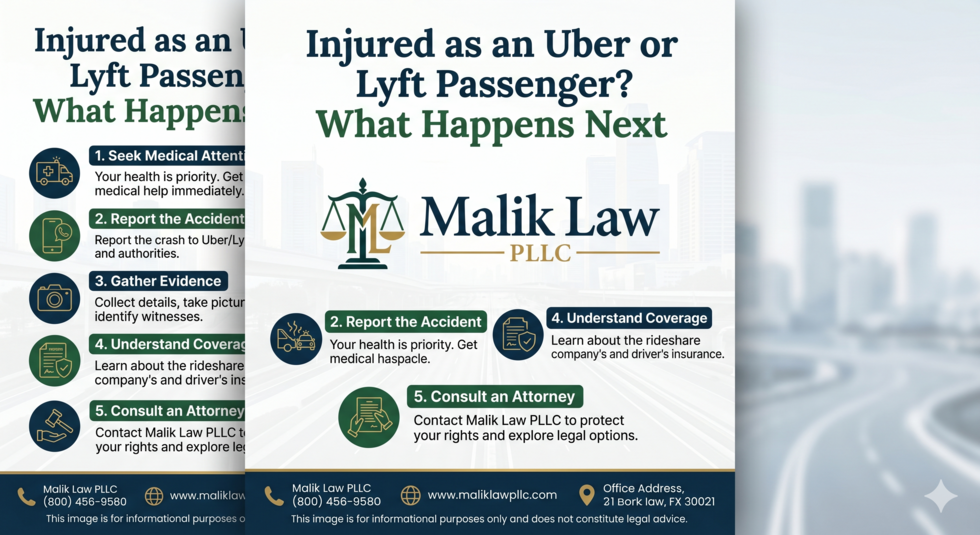
What to Do Right Now if You've Been in a Rideshare Accident
The steps you take in the hours and days after a rideshare accident can significantly affect the strength of your claim. Here's the order that protects you best:
-
Seek Medical Attention Immediately
Even if you feel "fine," some injuries — concussions, whiplash, internal trauma — don't show symptoms right away. A medical record created close to the time of the accident is also critical evidence for your claim.
-
Document Everything
Photograph the vehicles, the accident scene, road conditions, and your visible injuries. Take screenshots of your ride details and receipt from the Uber or Lyft app — this proves the exact trip status and timing.
-
Get a Police Report
Call the police to the scene whenever possible. An official report creates a neutral, third-party record of what happened and who was involved.
-
Collect Contact & Insurance Information
Get names, contact details, and insurance information for every driver involved — your rideshare driver and any third-party drivers.
-
Avoid Recorded Statements Before Speaking With an Attorney
Insurance adjusters — including Uber's and Lyft's own claims representatives — may contact you quickly. Be polite, but avoid giving a detailed recorded statement or accepting a settlement offer before you understand the full value of your claim.
-
Contact a Rideshare Accident Attorney
Identifying which of multiple possible insurance policies applies to your case — the driver's personal policy, the rideshare company's liability coverage, UM/UIM coverage, or a third-party driver's policy — is genuinely complex. An experienced attorney untangles this so no available coverage is left on the table.
Frequently Asked Questions
What happens if I'm injured as a passenger in an Uber or Lyft accident?
As a rideshare passenger, you are almost always considered zero percent at fault, regardless of who caused the crash. If your driver caused the accident, you're covered by the rideshare company's $1 million commercial liability policy. If a third-party driver caused the crash, you can pursue their personal auto insurance — and if that driver is uninsured or underinsured, the rideshare company's UM/UIM coverage may apply, subject to the coverage limits currently in effect in your state.
Does Uber or Lyft insurance actually cover passengers?
Yes. While you're a passenger during an active trip, Uber and Lyft maintain a $1 million third-party liability policy that applies if their driver caused the accident. This coverage exists specifically because rideshare drivers' personal auto insurance policies typically exclude commercial or "transportation network company" use — meaning the personal policy often won't pay at all during an active ride.
What changed with rideshare insurance in 2026?
In California, Senate Bill 371 took effect January 1, 2026, and significantly reduced uninsured/underinsured motorist (UM/UIM) coverage for rideshare passengers — from $1 million per person down to a much lower cap, roughly a 94% reduction. This change specifically affects situations where a third-party at-fault driver has no insurance or insufficient insurance; it does not affect the $1 million liability coverage that applies when the rideshare driver themselves causes the crash. Other states may see similar legislative changes, so checking your specific state's current rules with an attorney is essential.
Can I sue Uber or Lyft directly after an accident?
Generally, direct lawsuits against Uber or Lyft as companies are difficult because their drivers are classified as independent contractors rather than employees, which limits traditional vicarious liability claims. Most injured passengers resolve their claims through the company's insurance policy instead. However, in certain situations — such as negligent vetting of a driver with a dangerous history, or specific state laws on labor classification and liability — a more direct claim may be possible. This requires a detailed legal evaluation of your specific facts.
How much can I receive for a rideshare accident injury?
There's no universal number — it depends on the severity of your injuries, your medical expenses (current and future), lost income, and the available insurance coverage given the specific circumstances of your crash. Compensation can include medical expenses, lost wages, loss of earning capacity, pain and suffering, and emotional distress. Because the available coverage depends heavily on which "period" the trip was in and whether UM/UIM coverage is reduced in your state under recent law changes, getting an accurate estimate requires a detailed case review by an attorney familiar with rideshare claims.
What if the rideshare driver who hit me was just logged into the app but hadn't accepted a ride?
This is called Period 1 or "deadheading" — when a driver has the app open looking for fares but hasn't accepted a ride request. Coverage during this period is significantly lower than during an active trip, typically around $50,000 bodily injury per person, $100,000 per accident, and $30,000 property damage, and often only applies after the driver's personal insurance is exhausted or denied. If you were hit by a driver in this status (for example, as a pedestrian or in another vehicle), the coverage analysis is different and more limited than if you were an actual passenger during an active trip.
You Weren't Driving. You Shouldn't Be Fighting Alone.
Rideshare accident claims involve layers of insurance policies, multiple companies, and rules that changed significantly in 2026. Let the team at Malik Law PLLC identify every layer of coverage available to you — so nothing gets left on the table.

Comments
There are no comments for this post. Be the first and Add your Comment below.
Leave a Comment