
A layoff is devastating for anyone. But if you're living in the United States on a work visa, it hits differently. The moment your employer terminates your position, an immigration timer starts ticking — one that doesn't care about your job search timeline, your family situation, or how good your severance package is. The good news is you have real options. The bad news is the window to use them is short. Here's what you need to know right now.
- The moment your job ends — what legally happens to your status
- The 60-day grace period — what it means, what it doesn't
- Step 1: Find a new sponsor and transfer your visa
- Step 2: File a Change of Status while you figure things out
- Step 3: Other options — green card portability, dependents, and departure
- The most dangerous mistakes people make after a layoff
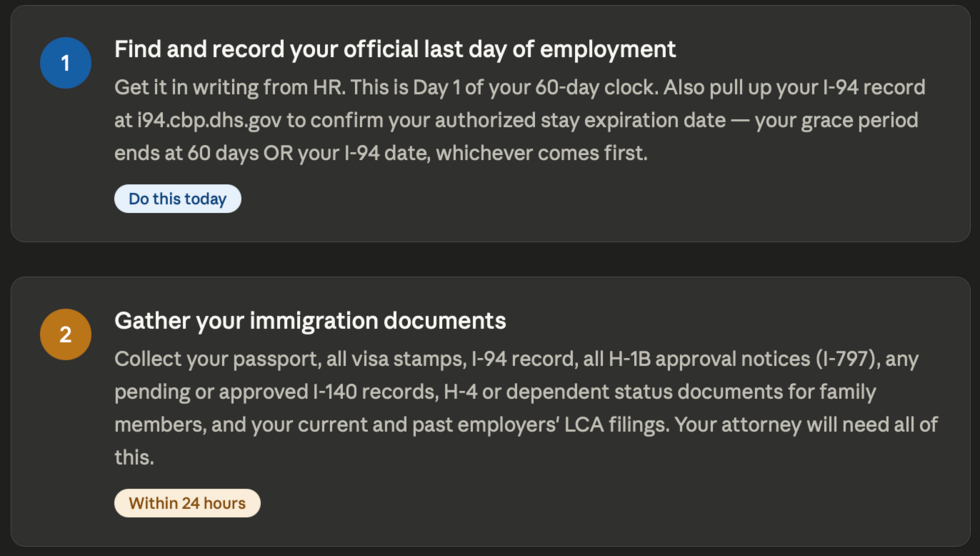
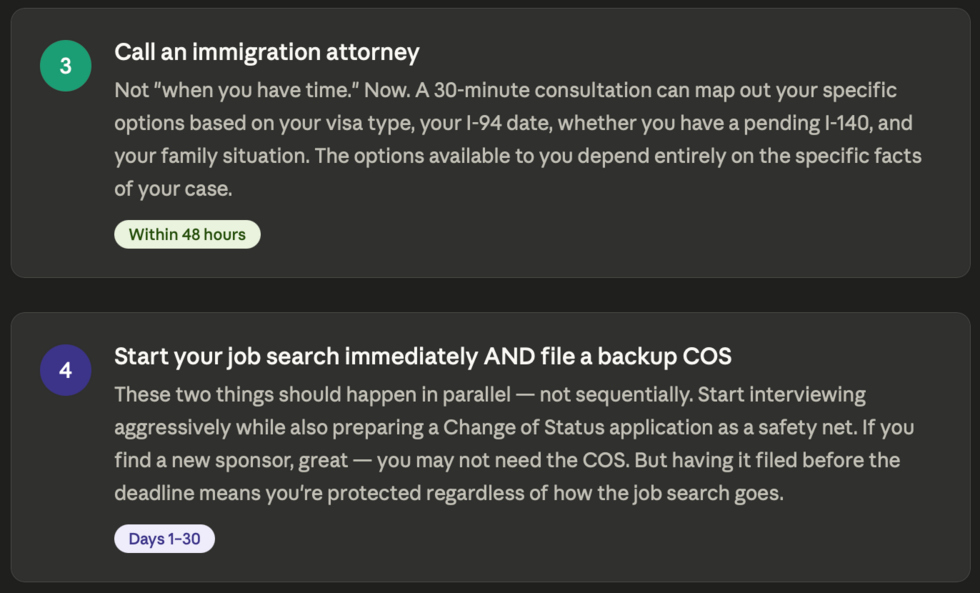
- Your first 48 hours — a practical action list
- Frequently asked questions
The moment your job ends — what legally happens to your status
Most work visas in the United States are employer-specific. That means your authorization to be in the country is tied directly to your employment with a particular company. When that employment ends — whether through a layoff, termination, or even resignation — your authorized employment stops immediately. Not in 30 days. Not when HR processes the paperwork. The same day.
Your former employer is legally required to notify USCIS by withdrawing your petition. Once that happens, your H-1B or other work status is no longer active in the way it was before. You are in what the regulations call a grace period — a narrow window created specifically to give you time to take action without falling out of status entirely.

The 60-day grace period is not printed on any document you receive. It exists in federal regulations at 8 CFR 214.1(l)(2). USCIS has discretion to shorten or deny it in individual cases. It is not a right you can rely on without taking action — it is a window. And windows close.
The 60-day grace period — what it means, what it doesn't
When your employment ends, federal regulations give most H-1B and many other nonimmigrant work visa holders up to 60 consecutive days — or until your I-94 expiration date, whichever comes first — during which you are considered to be in valid nonimmigrant status. You will not accrue unlawful presence during this window.
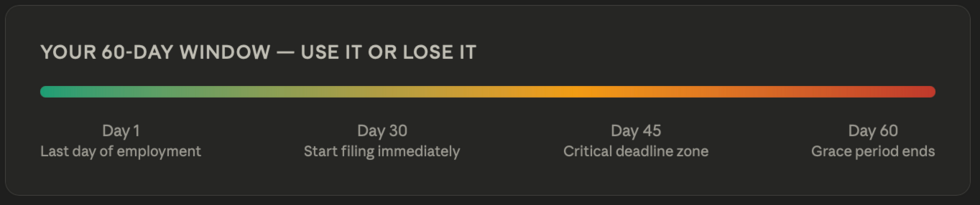
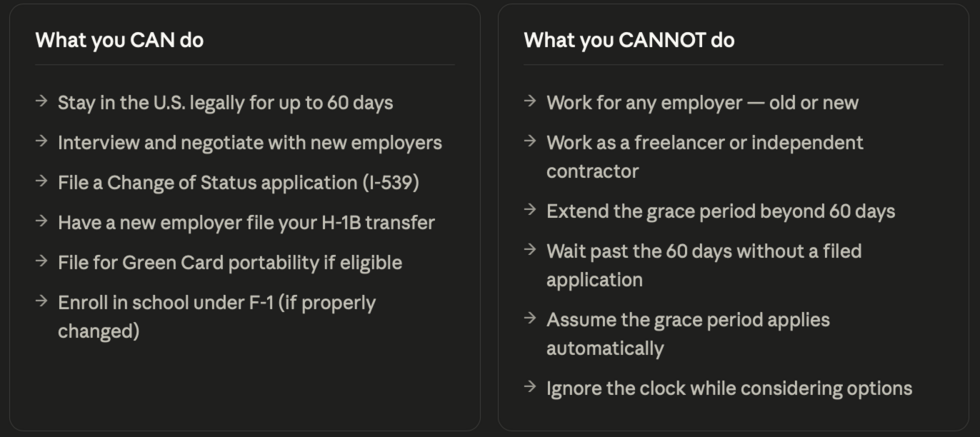
What the grace period allows: you can remain in the United States legally, file petitions or applications, interview for new jobs, and take the steps needed to change or extend your status. What the grace period does not allow: you cannot work. Not for your old employer, not for a new one — until a new employer has filed a proper H-1B petition on your behalf and you have received a USCIS receipt number.
Step 1 — Find a new sponsor and transfer your visa (H-1B Portability)
This is the fastest and cleanest option for most work visa holders. If you can find a new employer willing to sponsor you within the 60-day window, you can keep your H-1B status and — under the portability rules created by the AC21 Act — start working for the new company the moment they file your petition with USCIS.
You don't have to wait for approval. You don't have to leave the country. The moment your new employer files a non-frivolous H-1B petition and you receive the USCIS receipt number confirming it was received, you can begin work legally. That one fact changes the calculation entirely — it means your job search and your immigration timeline can run on parallel tracks.
Under H-1B portability rules (INA 214(n), AC21), you can begin working for a new H-1B employer as soon as USCIS receives their petition — you do not need to wait for approval. This is one of the most powerful protections available to skilled workers facing a layoff.
What the new employer needs to file
- Labor Condition Application (LCA) — filed with the Department of Labor, reviewed within about 7 business days
- Form I-129 (Petition for Nonimmigrant Worker) — filed with USCIS along with supporting documents
- Form I-907 (optional) — Premium Processing for a USCIS response within 15 business days, costing $2,805 in 2026 (many employers cover this)
One critical warning: if the petition is filed on day 59 or 60, USCIS may approve the transfer but deny the status extension — requiring you to leave the U.S., obtain a new H-1B visa stamp abroad, and re-enter before starting work. Filing early is not just advisable. In a layoff situation, it's essential.
Step 2 — File a Change of Status to buy time
What if you haven't landed a new job yet but you're not ready to leave the country? This is where a Change of Status (COS) application can give you the breathing room you need. If you file Form I-539 before your 60-day grace period expires, you are allowed to remain in the United States legally while USCIS processes your application — even if that takes months.
The key is that the application must be filed while you are still in valid status. If you wait until after the grace period expires, you've lost that legal foundation and the application will likely be denied. Filing early isn't just a good idea — it's the difference between having options and not having them.
Status options you can change to
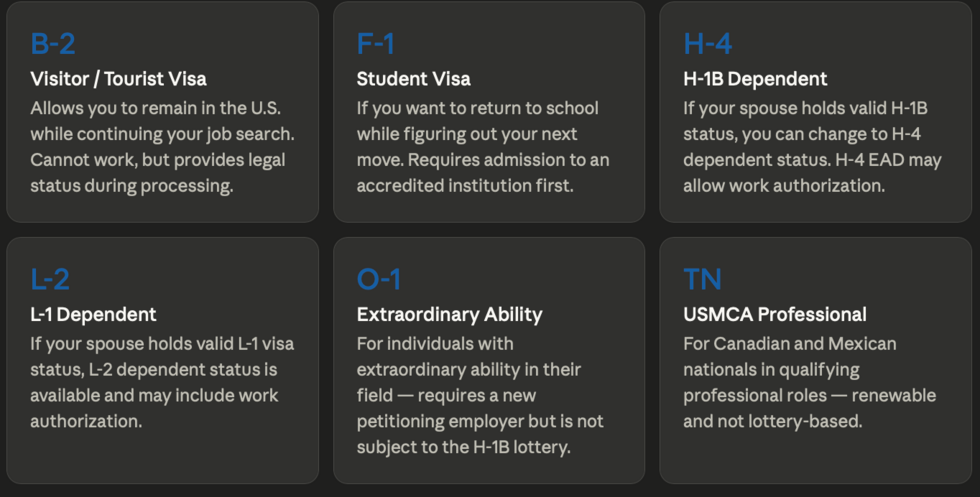
Filing a legitimate Change of Status application before your 60 days expire means you can remain in the United States legally while USCIS processes it — even if processing takes 6 to 12 months. This is often called a "bridge" strategy and it works, but only if the application is filed correctly and on time.
Step 3 — Other options worth knowing about
Green card portability (if you have an approved I-140)
If you're already in the green card process and have an approved I-140 petition with a current priority date, you may be eligible to file an Adjustment of Status (Form I-485) even after your employment ends. A pending I-485 puts you in a "period of authorized stay" and allows you to apply for a work permit (EAD). This is a powerful option — but it requires that your I-140 was already approved and your priority date is current. Don't travel internationally before receiving Advance Parole or USCIS may treat the case as abandoned.
Your family members' status
If your spouse or children are in the United States on dependent status tied to your work visa (H-4, L-2, etc.), your job loss affects them too. Their status is derivative of yours — meaning it becomes precarious the moment yours does. Don't forget to include your dependents when consulting with an attorney about your options.
Departing the United States
Sometimes the most legally safe decision is to leave before the grace period expires. Departing within the 60-day window means you leave with a clean immigration record — no unlawful presence, no bars to re-entry. This may be the right choice if no other option materializes in time. Leaving voluntarily is always better than falling out of status.
Severance pay does not extend your grace period. It is a financial and employment matter — not an immigration one. The clock runs from your last day of actual employment, regardless of whether severance payments continue afterward.
The most dangerous mistakes people make after a layoff
Over the years of representing work visa holders through job losses, we've seen the same avoidable errors come up repeatedly. Every one of them is preventable — but only if you act quickly and with good information.
- Waiting to see how the job search goes before consulting an attorney — the clock doesn't pause
- Assuming you have 60 full days no matter what — the grace period ends when your I-94 expires if that comes first
- Starting work for a new employer before a petition has been filed and the receipt received
- Filing a Change of Status application after the grace period has already expired
- Forgetting to account for dependent family members when filing or planning
- Traveling internationally during the 60-day period without understanding the re-entry risk
- Assuming unemployment insurance claims will automatically harm a future green card case (they typically don't — but get legal advice)
- Believing an employer's verbal offer protects you — only a filed USCIS petition creates legal protection
"In an H-1B layoff case, the most valuable asset is not optimism — it is decision speed tied to the correct dates. The most dangerous thing you can do is wait."
Frequently asked questions — work visa layoff 2026
- How long do I have after losing my job on a work visa?
- Can I work during the 60-day grace period?
- What is H-1B portability and how does it help after a layoff?
- What is a Change of Status and when should I file one?
- What happens to my spouse and children if I lose my work visa?
- Does severance pay extend my grace period?
- Can I collect unemployment benefits on a work visa without hurting my future immigration cases?
- What if I can't find a new job within 60 days?
- Is the 60-day grace period available for all work visas?

Comments
There are no comments for this post. Be the first and Add your Comment below.
Leave a Comment