
Family Immigration · Malik Law PLLC
What couples actually need to know — real processing times, step-by-step stages, the 2026 USCIS rule changes, and how to avoid the delays that cost people months of waiting.
📋 Marriage-Based ImmigrationIn 2026, a marriage-based green card takes 5 months to 3+ years depending on two things: whether your spouse is a U.S. citizen or a green card holder, and whether you're applying from inside or outside the United States. Spouses of U.S. citizens filing concurrently (I-130 + I-485) can see approval in 5–8 months. Standard cases for spouses of U.S. citizens typically take 10–24 months. Spouses of green card holders (F2A category) face a wait of 2–3 years or more.
You found each other. You built a life together. Now you just want the paperwork to catch up with reality. The marriage-based green card process is, at its heart, an act of faith — faith in a system that moves slowly, asks a lot of questions, and has a way of making one of the happiest decisions of your life feel like a bureaucratic ordeal.
But the waiting doesn't have to be a mystery. In 2026, with new USCIS rules in place and processing times shifting, the couples who navigate this process most successfully are the ones who understood the timeline before they filed — not after they hit their first delay. Let's walk through it together.
The First Question: Citizen Spouse or Green Card Holder Spouse?
Before anything else, this single fact determines your timeline more than any other factor in the process. U.S. immigration law treats these two situations very differently — and the gap in processing time can be measured in years.
| Your Situation | Visa Category | Annual Cap? | 2026 Typical Timeline |
|---|---|---|---|
|
Married to a U.S. Citizen |
Immediate Relative |
No cap — unlimited |
10–24 months (or 5–8 mo. concurrent filing) |
|
Married to a Green Card Holder |
F2A Preference |
Yes — subject to backlog |
2–3+ years depending on country of birth |
If your spouse is a U.S. citizen, you are classified as an "immediate relative" — the most favorable category in all of U.S. immigration law. There is no annual limit on immediate relative visas, which means your case moves as quickly as USCIS can process it. No waiting for a visa number to become available.
If your spouse is a permanent resident (green card holder), your case falls under the F2A preference category, which has a limited number of visas issued each year. When demand exceeds supply — and it often does — a backlog forms. As of early 2026, the wait for F2A applicants is running two to three years in many cases, and longer for nationals of high-demand countries.
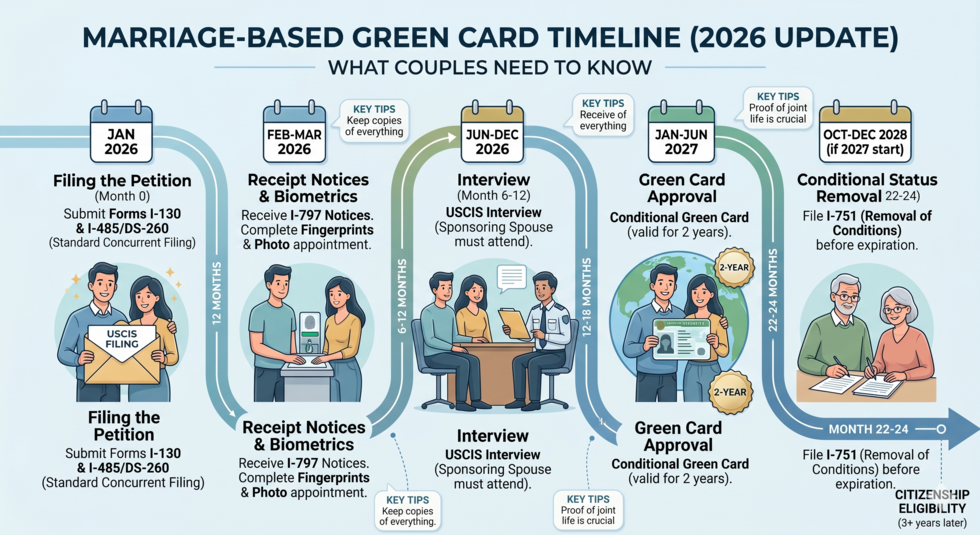
The 2026 Marriage Green Card Timeline, Stage by Stage
Every marriage-based green card application moves through the same core stages — but the length of each stage depends on your specific path. Here's how the full process breaks down:
The U.S. citizen or permanent resident spouse files Form I-130 to establish the legal family relationship. This is the foundation of the entire case. If you are already lawfully in the U.S. and married to a U.S. citizen, you may be able to file the I-130 and I-485 simultaneously — skipping a separate wait period for I-130 approval.
Adjustment of Status (Form I-485) — For foreign spouses already lawfully present in the U.S. You apply without leaving the country and can request work authorization (EAD) and travel permission (Advance Parole) at the same time.
Consular Processing — For foreign spouses abroad. After I-130 approval, the case transfers to the National Visa Center (NVC) for document review, then to a U.S. embassy or consulate for an immigrant visa interview. You receive an immigrant visa to enter the U.S., after which you become a permanent resident upon entry.
USCIS schedules you for fingerprinting, a photo, and signature collection at a local Application Support Center. This is a routine step — but missing it without rescheduling promptly can stall your entire case.
If you filed Form I-765 with your I-485, you'll receive an Employment Authorization Document (EAD) allowing you to work legally in the U.S. while your case is pending. Form I-131 (Advance Parole) allows you to travel internationally without abandoning your adjustment application. Do not travel internationally without Advance Parole while your I-485 is pending.
You must be examined by a USCIS-designated civil surgeon — not your personal physician. The completed I-693 must now be submitted with your I-485 at time of filing rather than brought to the interview.
In 2026, USCIS has reinstated mandatory in-person interviews for nearly all marriage-based green card applicants. Both spouses typically appear together at a local USCIS field office. Officers will ask questions to verify the marriage is genuine — expect questions about your daily life together, how you met, living arrangements, finances, and your relationship timeline. Preparation matters enormously here.
If your case is approved at or after the interview, USCIS will mail your green card. If your marriage was less than two years old when approved, you'll receive a 2-year conditional green card. If married more than two years, you receive a 10-year permanent green card directly

What Changed in 2026: Key USCIS Updates Every Couple Must Know
The marriage-based green card process in 2026 is meaningfully different from even two years ago. Policy shifts, new form requirements, and tightened vetting procedures affect nearly every application filed this year. Here's what's new:
🔔 2026 USCIS Policy UpdatesDocuments You'll Need: The Core Filing Package
The marriage-based green card process is documentation-intensive by design — USCIS must verify both the legal validity of your marriage and its genuine, bona fide nature. One missing or incorrect document can result in rejection, delay, or a Request for Evidence. Here's what the core filing package typically includes
- Form I-130 + I-130A
- Proof of U.S. citizenship or permanent residency
- Valid government-issued ID
- Birth certificate
- Divorce decrees (if previously married)
- Form I-485 (if in U.S.)
- Valid passport & current visa
- Birth certificate
- Police clearance certificates
- Form I-693 (civil surgeon medical)
- Official marriage certificate
- Joint bank account statements
- Shared lease or mortgage
- Joint insurance policies
- Photos together over time
- Communication records, travel together
- Form I-864 (Affidavit of Support)
- Last 3 years of tax returns
- Recent pay stubs
- Employment letter
- Bank statements
- Form I-765 (EAD application)
- Form I-131 (Advance Parole)
- 2 passport-style photos
- DS-260 immigrant visa application
- NVC document submission
- Medical exam at approved facility abroad
- Consular interview appointment
What Slows Cases Down: The Most Common Delays in 2026
Most delays in the marriage green card process are preventable. Here are the situations our clients most often come to us with — after the delay has already happened:
- Filing the new I-485 version without the required I-693 medical exam — USCIS may reject the entire packet.
- Incomplete or inconsistent bona fide marriage evidence — thin files are the leading cause of Requests for Evidence in 2026.
- Missing biometrics appointments without timely rescheduling — even a valid reason doesn't automatically excuse a missed appointment.
- Traveling internationally while I-485 is pending without Advance Parole — this can be treated as abandonment of the adjustment application.
- Working without valid EAD — jeopardizes the application and creates inadmissibility issues.
- Name discrepancies between documents — different spellings, middle names omitted, or translation errors cause RFEs.
- Prior immigration violations, overstays, or visa issues that require a waiver — these must be addressed proactively, not reactively.
- F2A applicants who fail to monitor the Visa Bulletin for priority date movements and miss their filing window.
The Conditional Green Card: What It Is and How to Remove the Conditions
Here's something that surprises many couples: if your marriage was less than two years old when your green card is approved, you won't receive a standard 10-year green card. Instead, you'll receive a 2-year conditional permanent resident card.
This isn't a penalty — it's a congressionally built-in verification step. USCIS wants to see whether the marriage continues to be genuine after the green card is in hand.
How to Remove the Conditions (Form I-751)
During the 90-day window before your conditional card expires, you and your spouse must file Form I-751 (Petition to Remove Conditions on Residence) jointly. You'll need to demonstrate that your marriage was entered in good faith and that it still exists. Joint financial documents, continued cohabitation evidence, and children born to the marriage are all relevant.
If the marriage has ended — through divorce, separation, or the death of your spouse — you may still be eligible to file a waiver of the joint filing requirement, provided you can show the marriage was genuine. The I-751 waiver process is more complex and almost always benefits from legal representation.
Frequently Asked Questions: Marriage Green Card 2026
How long does a marriage-based green card take in 2026?
It depends on your situation. For spouses of U.S. citizens filing concurrently inside the U.S. (I-130 + I-485 together), the timeline is typically 5–8 months for straightforward cases. Standard cases for spouses of U.S. citizens take 10–24 months. Spouses of green card holders (F2A category) face waits of 2–3 years or more, depending on country of birth and current Visa Bulletin priority dates. Consular processing cases generally take longer than in-country adjustment of status.
Can I work in the U.S. while my marriage green card application is pending?
Yes — but only after you receive your Employment Authorization Document (EAD). You must file Form I-765 (usually with your I-485) and wait for USCIS to issue the EAD. In 2026, EAD processing generally takes 3–7 months. Do not work for a U.S. employer without valid work authorization, even if your case is pending. Unauthorized employment creates inadmissibility issues that can jeopardize your green card.
Can I travel outside the U.S. while my I-485 is pending?
Only with an approved Advance Parole document (Form I-131). Leaving the U.S. while your I-485 is pending without Advance Parole is generally treated as abandonment of your adjustment application — meaning USCIS will close your case and you'll have to restart. File for Advance Parole with your I-485 and wait for approval before any international travel.
What happens at the USCIS marriage green card interview in 2026?
Both spouses typically appear together at a USCIS field office. The officer will review your documents and ask questions to determine whether the marriage is bona fide — meaning genuine, not entered into solely for immigration benefits. Questions commonly cover: how you met, your first date, your living arrangements, daily routines, shared finances, family members, and relationship milestones. In 2026, interviews are mandatory for nearly all marriage-based cases. Officers may also conduct a Stokes interview (separate questioning of each spouse) if they have concerns about the marriage's genuineness.
What is the difference between a conditional and permanent green card?
My spouse is a green card holder, not a U.S. citizen. How does that affect my timeline?
What happens if my green card application is denied?
Your Timeline Starts With the Right Strategy
Every marriage green card case is different — and the path that's fastest and safest for you depends on your specific facts. At Malik Law PLLC, we review your situation, map out your best route, and build an application designed to move efficiently and hold up under scrutiny.Confidential consultation · No obligation · maliklawpllc.com

Comments
There are no comments for this post. Be the first and Add your Comment below.
Leave a Comment