
Most people think estate planning is for the elderly or the ultra-wealthy. They're wrong — and the real cost of that assumption falls not on them, but on the people they love most.
You urgently need a wills and estate attorney if you have experienced any of the following: had a child (guardian designation), gotten married or divorced (beneficiary updates), own a business (succession planning), own real estate in more than one state (multi-state probate avoidance), or had a health scare (healthcare directive and power of attorney). A will alone is not enough — it does not avoid probate. A properly structured estate plan, including a living trust, protects your family, your privacy, and your assets.
Nobody sits down one day and decides it's finally time to think about dying. It doesn't work that way. What actually happens is this: someone you know loses a parent unexpectedly, or a friend's divorce drags on for two years because of an outdated will, or a colleague's family fights over a business with no succession plan in place. And suddenly it's not abstract anymore. Suddenly you're thinking: what would happen to my family if something happened to me?
That question deserves a real answer. Not a rough idea. Not a beneficiary form you filled out a decade ago. A real, legally airtight plan — built by someone who knows exactly what the courts will do if you leave things to chance.
Let's walk through the signs — the real-life situations that mean you need to pick up the phone and call a wills and estate attorney. Not someday. Now.
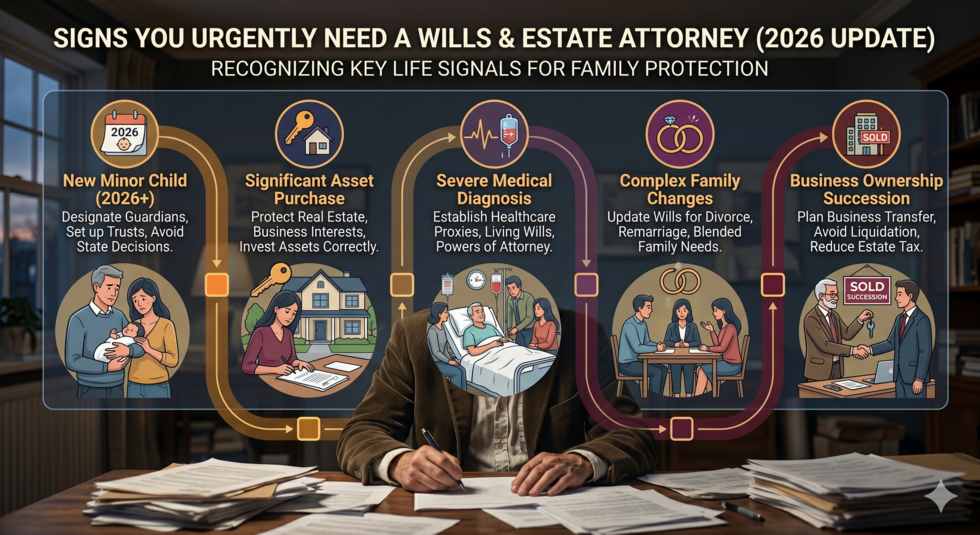
The Signs: When "I'll Do It Later" Becomes Dangerous
You Have Minor Children
This is the single most urgent reason to have an estate plan. A will is the only legal document that allows you to name a guardian for your minor children. Without one, if something happens to both parents, a judge who has never met your family will decide who raises your children — and that person may not be who you would have chosen.
Think about that for a moment. A stranger in a courtroom deciding whether your children go to your sister in Portland or your in-laws in Florida, with everyone grieving and potentially disagreeing.
Beyond guardianship, new parents need a trust structure to manage any assets or life insurance proceeds for minor children. Without it, a court may appoint a conservator to manage those funds — another layer of expense and lost control. And if your child receives a large inheritance at 18 with no guidance structure around it, the results are often devastating.
You Recently Got Married — or Divorced
Marriage and divorce are the two most commonly overlooked estate planning triggers — and the two most dangerous ones if ignored.
If you just got married: Your existing will, beneficiary designations, and powers of attorney were written for your life before your spouse existed in it. In many states, a new marriage does not automatically update your beneficiary designations on retirement accounts and life insurance. That means your ex-partner, your parents, or even a charity you named years ago could receive assets your spouse expected to inherit.
If you just got divorced: Some states automatically revoke ex-spouse provisions in a will upon divorce — but many do not, and beneficiary designations on retirement accounts and life insurance are almost never automatically updated. There are documented cases of ex-spouses receiving life insurance payouts years after a bitter divorce because the policy was never changed. Do not assume the legal system cleaned this up for you. It didn't.
You Want to Avoid Probate — and You Think a Will Does That
This is one of the most widespread misunderstandings in estate planning, and it costs families significant time and money every year: a will does not avoid probate. A will is, at its core, a set of instructions for the probate court. The moment it goes into effect, it enters the public record and goes through a supervised court process before your assets can be distributed to your heirs.
Probate in most states is public — meaning anyone can look up what you owned and who received it. It can take anywhere from 6 to 24 months, and it typically costs 1% to 7% of the estate's value in legal fees, court costs, and administrative expenses. On a $500,000 estate, that's up to $35,000 gone before your family sees a dollar.
To truly avoid probate, you need a revocable living trust. Assets held in a trust pass directly to beneficiaries, without court involvement, without public disclosure, and on a timeline measured in weeks — not years.
| Feature | Last Will & Testament | Revocable Living Trust |
|---|---|---|
|
Avoids Probate? |
No | Yes |
|
Keeps Finances Private? |
No — public record | Yes — fully private |
|
Distribution Timeline |
6–24 months via court |
Weeks — no court needed |
|
Covers Minor Children? |
Limited | Yes — with trust provisions |
|
Incapacity Protection? |
No | Yes — successor trustee takes over |
|
Cost of Probate |
1%–7% of estate value |
None |
You Own a Business
If you own a business and you don't have a succession plan, you don't just have an estate planning gap — you have a business continuity crisis waiting to happen. Without a clearly documented succession plan, the death or incapacity of a business owner can force a company into immediate legal limbo. Partners may disagree. Banks may freeze credit lines. Employees may leave. Clients may panic.
A business succession plan, integrated into your estate plan, answers three critical questions: Who takes over the business? How is the business valued for estate purposes? And how do you ensure your heirs receive fair value — whether that means continuing the business, buying out co-owners, or selling it in an orderly way?
Buy-sell agreements, funded by life insurance, are a common structure for business partners — they ensure that if one partner dies, the surviving partner(s) can buy out the deceased's share at a pre-agreed price, preventing the deceased's heirs from becoming unwanted business co-owners and the business from falling apart.
You Have No Healthcare Directive or Power of Attorney
Estate planning isn't only about what happens when you die. It's about what happens if you can't speak for yourself.
A Healthcare Directive (also called an Advance Directive or Living Will) is a legal document that tells your doctors and family exactly what medical treatment you do — and don't — want if you become incapacitated. Without one, your family may be forced to make agonizing decisions with no guidance, sometimes while disagreeing with each other. Doctors may be legally required to take heroic measures you would never have wanted.
A Durable Power of Attorney for Finances authorizes a trusted person to manage your bank accounts, pay your bills, and make financial decisions if you are mentally or physically incapacitated. Without one, your family may need to go through a court-supervised conservatorship process — expensive, slow, and deeply invasive — just to access money to pay your mortgage while you're in a hospital bed.
These are not documents for the elderly. A car accident, a sudden stroke, or an unexpected surgery can create exactly this situation at any age.
You Own Real Estate in More Than One State
Owning a vacation home, rental property, or investment real estate in another state creates a probate nightmare that many families don't discover until it's too late. When you die owning real property in multiple states, your estate typically must go through ancillary probate — a separate probate proceeding — in each state where you own real estate.
That means multiple attorneys, multiple court filing fees, multiple timelines, and multiple opportunities for something to go wrong. If you own property in three states, your heirs may face three simultaneous probate proceedings before any of that real estate can be transferred.
The solution is straightforward but must be executed correctly: transferring real estate into a properly drafted revocable living trust removes those properties from the probate estate entirely. When you die, the successor trustee transfers title directly — no court in any state required.
Your Estate Plan Is More Than 3–5 Years Old
An estate plan is not a one-time task. It's a living set of documents that must evolve with your life. An estate plan written before your divorce, before your business grew, before the birth of your grandchildren, or before a significant change in tax law may actively work against your intentions.
Consider what has changed in your life in the last five years: marriages, divorces, new children or grandchildren, deaths of named executors or guardians, significant asset acquisition or loss, relocation to a new state, or changes in your relationships with named beneficiaries. Any one of these events can render key parts of your estate plan outdated or even counterproductive.
In 2026, the federal estate tax exemption rose to $15 million per individual ($30 million for married couples) under the One Big Beautiful Bill Act — a significant change from prior years. Estate plans built around previous exemption levels may need restructuring. And twelve states plus Washington D.C. still have their own estate taxes with lower exemptions, making state-level planning essential regardless of federal exemption changes.
What Actually Happens When There's No Plan: The Real Consequences
It's easy to treat estate planning as an abstract future problem. Here is what concretely happens to families who don't have one:
- A court — not you — chooses who raises your children, based on legal standards and available petitioners, not your personal wishes or knowledge of your family dynamics.
- Your estate enters public probate proceedings, making your assets, debts, and beneficiaries visible to anyone who looks — including creditors, distant relatives, and people you wouldn't have invited to the reading of your will.
- Your family waits 6 to 24 months before receiving any assets held in your name, while court costs and attorney fees quietly consume 1–7% of your estate's value.
- Your ex-spouse may legally receive your retirement account or life insurance proceeds if you never updated the beneficiary designation — regardless of what your will says, because beneficiary designations override wills.
- If you become incapacitated without a power of attorney, your family may be legally unable to access your bank account to pay your mortgage, utilities, or medical bills without an expensive court-supervised conservatorship.
- Your business may be forced to cease operations or undergo emergency sale while your estate is being settled, destroying years of built equity.
- Family members who disagree about your wishes have no legal document to settle the dispute — leading to litigation that consumes assets and relationships simultaneously.
What a Comprehensive Estate Plan Actually Looks Like
A properly drafted estate plan from a qualified attorney is not just a will in a drawer. For most families and individuals, a complete plan includes all of the following:
- Revocable Living Trust — Your primary vehicle for asset management during life and distribution at death, avoiding probate entirely.
- Pour-Over Will — Captures any assets not transferred into the trust and "pours" them in at death, serving as a safety net.
- Guardian Designation — Names your chosen guardian(s) for minor children in the event both parents are unable to care for them.
- Durable Power of Attorney for Finances — Authorizes a trusted person to manage financial affairs if you become incapacitated.
- Healthcare Directive / Advance Directive — Specifies your medical treatment wishes and designates a healthcare proxy to make decisions on your behalf.
- HIPAA Authorization — Allows named individuals to access your protected health information, without which even close family may be legally barred from speaking with your doctors.
- Beneficiary Designation Review — Ensures retirement accounts, life insurance, and payable-on-death accounts align with your overall estate plan strategy.
- Business Succession Documents — If applicable: buy-sell agreements, business valuation, and operating agreement amendments designating succession.
Frequently Asked Questions
What happens if I die without a will?
You die "intestate" — meaning your state's intestacy laws control who receives your assets and, critically, who raises your children. Most states distribute assets to a surviving spouse and children in a legally fixed order. If you have no close family, assets may pass to distant relatives or even the state. There is no consideration for your personal relationships, preferences, or the actual needs of the people you care about. A court will appoint a guardian for your minor children based on available petitioners and legal standards — not on your personal knowledge of who would be the best choice.
Does a will avoid probate?
No — this is one of the most important things to understand about estate planning. A will must go through probate before your assets can be distributed. Probate is a public court process that takes 6–24 months in most states and can cost 1–7% of the estate's value in legal fees and court costs. To avoid probate entirely, you need a revocable living trust. Assets held in a properly funded living trust pass directly to beneficiaries without court involvement, without public disclosure, and in a fraction of the time.
How much does a wills and estate attorney cost?
Costs vary depending on the complexity of your estate and the documents needed. A simple will may cost $300–$1,000. A comprehensive estate plan with a revocable living trust, powers of attorney, and healthcare directives typically ranges from $1,500 to $5,000 for individuals, and $3,000 to $8,000 for couples. While this may feel significant, compare it to the cost of probate — which can consume $10,000 to $50,000 or more of your estate's value — or the cost of a family legal dispute that proper documentation would have prevented. An estate plan is one of the highest-return investments a family can make.
When should I update my estate plan?
You should update your estate plan immediately after any major life event: marriage or divorce, birth or adoption of a child, death of a named executor, guardian, or beneficiary, significant change in your assets or net worth, purchase of real estate, start or sale of a business, or relocation to a different state (estate laws vary significantly by state). Even without a major event, a comprehensive review every 3–5 years ensures your plan stays current with both your life and changes in estate tax law.
What is a healthcare directive and why do I need one if I'm healthy?
A healthcare directive specifies your medical treatment wishes if you become unable to communicate — including preferences about life-sustaining treatment, resuscitation, and end-of-life care. It also designates a healthcare proxy who can make medical decisions on your behalf. The reason healthy people need one is straightforward: accidents and sudden illness don't wait for permission. Car accidents, strokes, and surgical complications happen to people of all ages. Without a healthcare directive, your family may face impossible decisions without guidance, and may disagree with each other — sometimes publicly, and painfully. Having the document doesn't mean you expect to need it. It means you're prepared in case you do.
Can I just use an online will template instead of hiring an attorney?
Online will templates can create a legally valid basic will for very simple estates — but they carry significant risks that most people don't discover until it's too late. Templates cannot account for state-specific legal requirements that affect validity. They don't help you structure assets to avoid probate. They can't integrate your retirement account beneficiary designations with your overall plan. They don't cover business succession, multi-state real estate, or blended family complexities. And they can't flag the legal landmines in your specific situation. An attorney doesn't just draft documents — they identify what you don't know you need to address. For most families, that identification alone is worth the cost of professional representation.
Your Family Deserves a Real Plan — Not a Rough Idea.
The hardest part of estate planning isn't the legal paperwork. It's making yourself sit down and do it. Our team at Malik Law PLLC makes that process straightforward, compassionate, and built around your actual life — not a generic template.
📞 +1 206-771-6207 📧 [email protected] 🌐 maliklawpllc.com
Comments
There are no comments for this post. Be the first and Add your Comment below.
Leave a Comment