
If you run a company outside the United States and you've been eyeing the American market, there's a question you've probably asked: how do I get my key people over there without getting caught in visa lottery uncertainty or endless wait times? The answer, in many cases, is the L-1 intracompany transferee visa — one of the most powerful and underutilized corporate immigration tools available. Here's everything you need to know to use it effectively in 2026.
- What the L-1 visa is and why it matters for growing companies
- L-1A vs. L-1B — which category fits your employee
- Core eligibility requirements in plain language
- The new office petition — expanding from scratch
- The L-1 green card advantage — EB-1C and dual intent
- Family benefits — L-2 work authorization
- The blanket petition — a faster path for large companies
- L-1 vs. H-1B — which is better for your situation
- Frequently asked questions
What the L-1 visa is and why it matters for growing companies
Every year, companies around the world make the decision to enter the U.S. market. Some get stuck at the very first obstacle: how to bring their experienced leadership team with them. The H-1B lottery is unpredictable, the EB-5 investor visa has steep financial requirements, and starting completely fresh with U.S.-hired staff means losing the institutional knowledge that made the company successful in the first place.
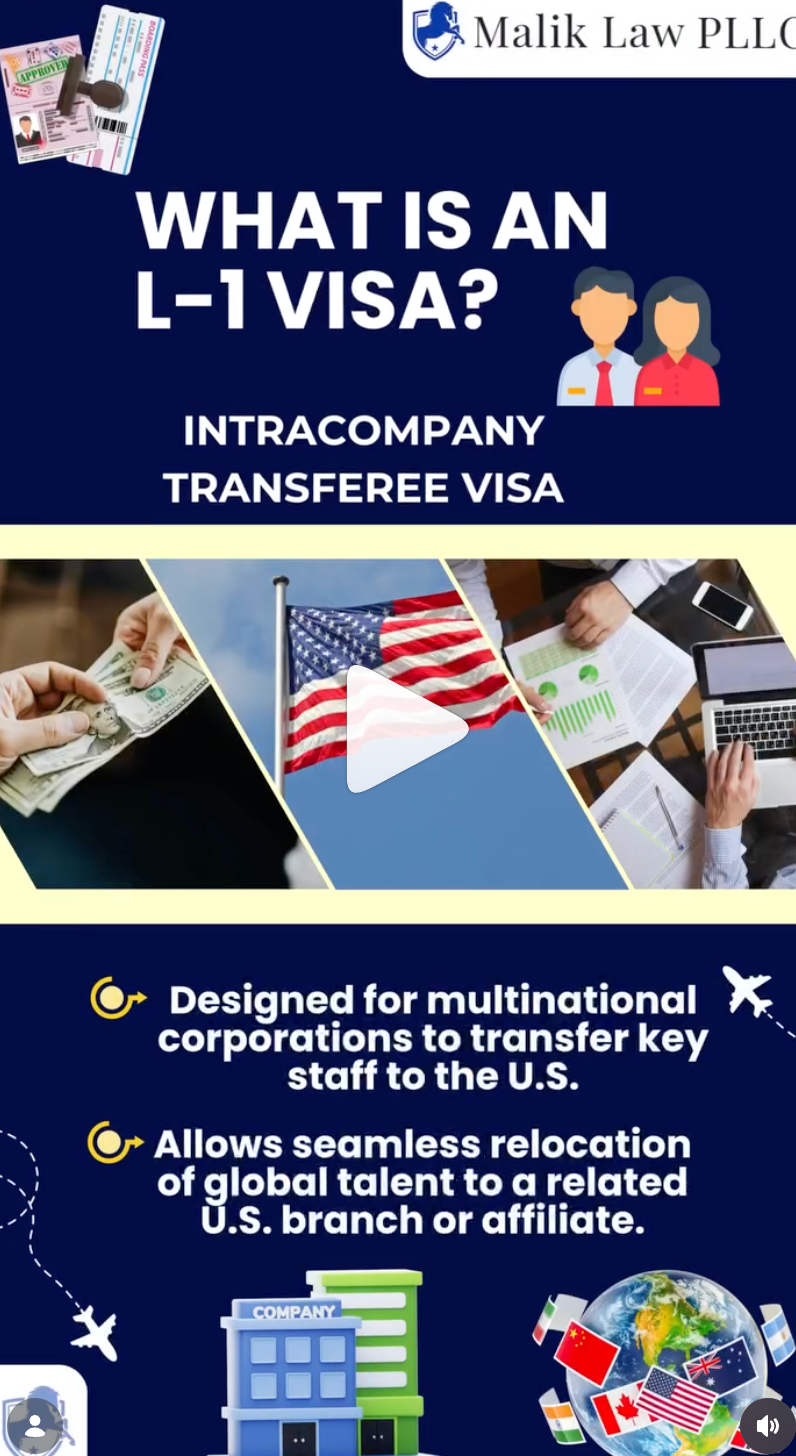
The L-1 visa exists precisely to solve this problem. It allows managers, executives, and employees with specialized knowledge who work outside the U.S. for a company with an affiliated entity inside the U.S. to come to the U.S. and perform services for that entity. No lottery. No annual cap. No requirement to prove there are no qualified American workers for the role. It is purely an intracompany transfer — your company, your people, your expansion.

The L-1 visa has no annual numerical cap and no lottery. Qualifying companies can file petitions year-round, at any time, for as many eligible employees as needed. This predictability is exactly what corporate expansion planning requires.
L-1A vs. L-1B — which category fits your employee
The L-1 visa comes in two versions, and which one applies depends entirely on the nature of the employee's role — not their seniority, their salary, or how important they are to the company. Getting this classification right at the application stage is critical, because USCIS scrutinizes it closely and misclassification is a leading cause of denials and RFEs (Requests for Evidence).
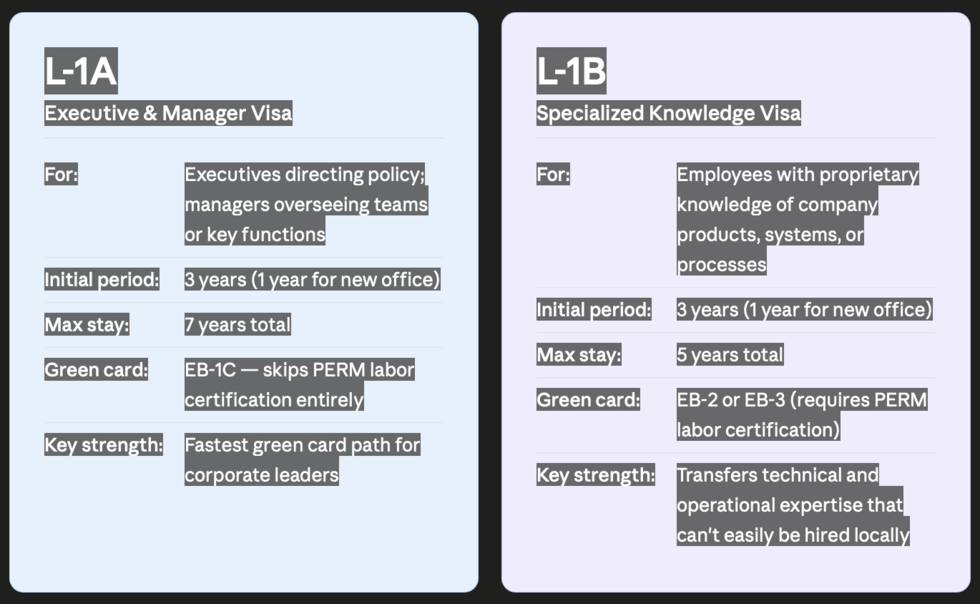
Understanding "specialized knowledge" — the most litigated L-1 question
The L-1B category trips up a surprising number of applicants because "specialized knowledge" sounds straightforward but is legally quite specific. It doesn't simply mean the employee is skilled or experienced. USCIS looks for knowledge that is genuinely proprietary — specific to the company's particular products, services, research, equipment, management techniques, or procedures — and that is not readily available elsewhere in the U.S. labor market.
An engineer who is highly skilled in their field does not automatically qualify for L-1B. The knowledge must be specific to the company — its internal systems, its proprietary methods, its unique processes. Generic industry expertise, no matter how advanced, typically does not meet the standard. The petition must document this specificity in detail.
Core eligibility requirements — in plain language
There are two sets of requirements for the L-1 visa: requirements about the companies involved, and requirements about the employee. Both must be satisfied for a petition to succeed.
The company relationship requirement
The U.S. company and the overseas company must be related by at least 50% common ownership and/or control. The recognized relationships are: parent company and subsidiary, sister companies with a common parent, branch offices of the same company, and affiliates with majority ownership by the same person or entity. This relationship must be documented thoroughly — corporate structure charts, ownership records, and organizational documents are all required.
- Parent company → U.S. subsidiary (most common structure)
- Foreign subsidiary → U.S. parent company
- Two sister companies with the same majority owner
- Foreign branch office → U.S. headquarters
- Joint ventures where at least 50% common ownership exists
The employee requirement — the one-year rule
Under U.S. immigration law, a worker qualifies for an L-1 visa if the person has been employed outside the U.S. by the sponsoring company for at least one continuous year out of the past three years, and is being transferred to the U.S. to work as a manager, executive, or specialized knowledge worker. That one-year clock counts from the date of filing — not the date the visa is issued — and gaps in employment can create complications.
One frequently misunderstood rule: the one-year qualifying employment must have been abroad — time the employee spent working in the U.S. for the same company does not count toward the one-year requirement. If your key employee has already spent significant time at the U.S. office, verify the qualifying foreign employment period carefully before filing.
The new office petition — expanding your business from scratch
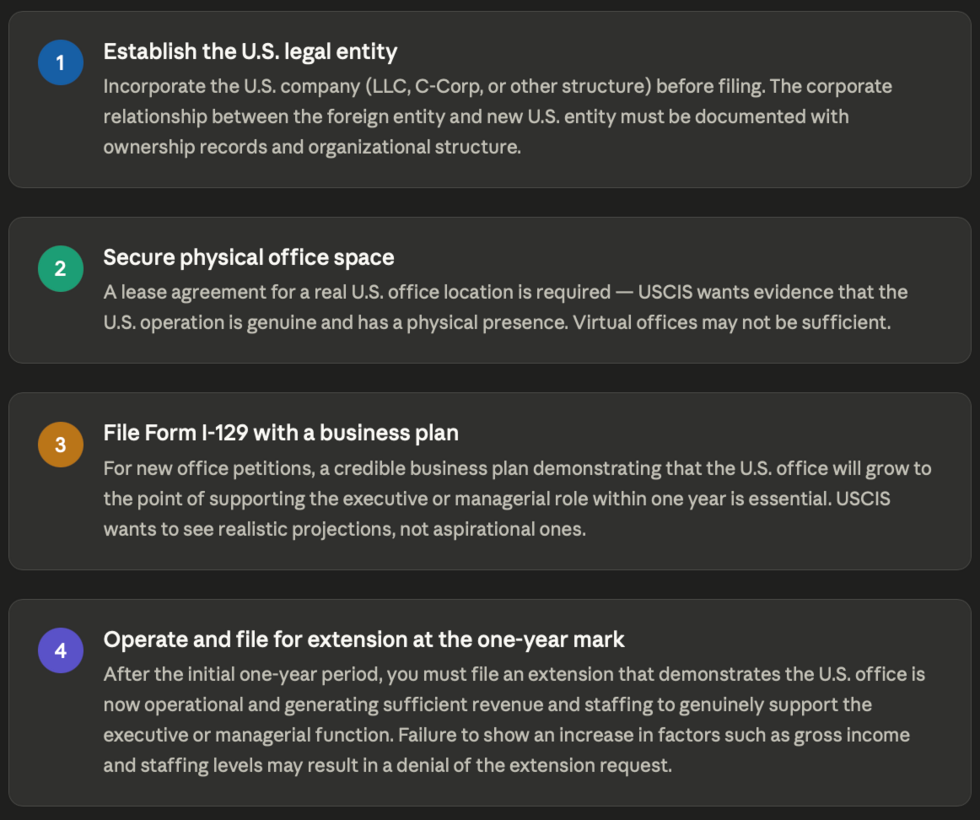
Here's where the L-1 visa becomes genuinely remarkable for entrepreneurs and companies making their first move into the U.S. market: a newly established U.S. office can qualify for an initial L-1 approval even before it fully supports a manager or executive role day to day. You don't need an established U.S. operation before you can bring your first executive over to build it.
This is called the "new office" L-1 petition. It allows a foreign company to send an executive or manager to the United States specifically to establish a new branch, subsidiary, or affiliate. The initial visa is granted for one year — a runway period to get the operation off the ground.
The L-1 green card advantage — EB-1C and dual intent
For most work visa holders, pursuing permanent residency creates a legal tension: if you apply for a green card, are you admitting you intend to stay permanently, which undermines your nonimmigrant status? The L-1 visa eliminates that tension entirely. It is a dual-intent visa, meaning you can simultaneously hold L-1 status and pursue a green card without any conflict. USCIS explicitly recognizes this.
But the green card advantage for L-1A holders goes even further. Executives and managers on L-1A visas can pursue permanent residency through the EB-1C category — the multinational executive or manager green card — which completely bypasses the PERM labor certification process that adds years to most employment-based green card timelines.
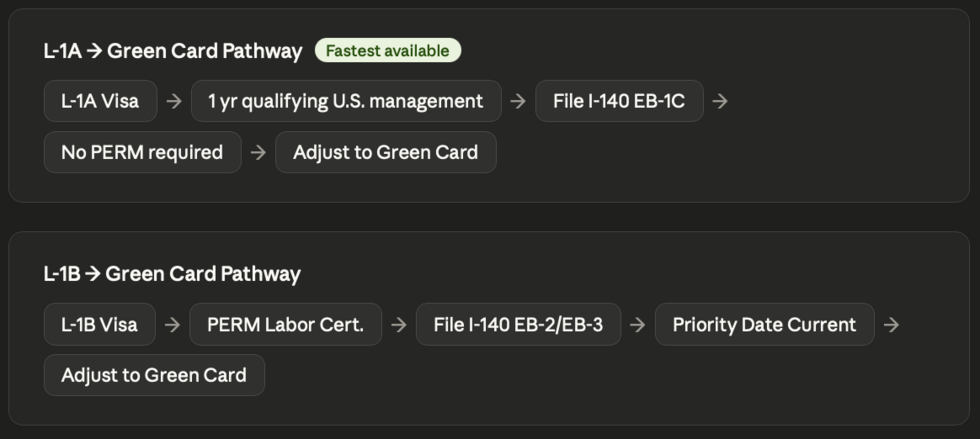
The EB-1C category for multinational executives and managers is one of the few employment-based green card paths that skips PERM labor certification entirely. For L-1A holders with one year of qualifying U.S. managerial experience, this is often the fastest route to permanent residency available in the entire immigration system.
An intracompany manager or executive has greater options for green card processing, as long as he or she has one year of executive or managerial experience with the company abroad prior to coming to the U.S. That means the green card planning for L-1A holders should begin well before the petition is filed — not after the visa is approved.
Family benefits — L-2 spouse work authorization
One of the most practically significant and least publicized benefits of the L-1 visa is what it does for the visa holder's family. Spouses and unmarried children under 21 who accompany an L-1 holder to the United States receive L-2 dependent status — and for spouses, that status comes with immediate, automatic work authorization.
Under current USCIS policy, L-2 spouses are employment authorized incident to their status. That means the moment an L-2 spouse is admitted to the United States with their L-2 visa, they can legally work — for any employer, in any field. No separate Employment Authorization Document application. No months of waiting. The work authorization is tied directly to the L-2 visa itself.
L-2 spouses have automatic work authorization incident to their status — confirmed by USCIS policy. They do not need to file a separate Form I-765 or wait for an EAD card to begin working. This is a significant family benefit that puts the L-1 visa well ahead of most other work visa categories for accompanying spouses.
The blanket petition — a faster path for large multinational companies
Companies that transfer employees to the U.S. regularly have another option: the blanket L petition. Instead of filing individual I-129 petitions for each employee — which takes time and resources — qualifying large companies can establish a pre-approved blanket relationship with USCIS that streamlines future transfers significantly.
Blanket petition eligibility requirements
- The petitioner and qualifying organizations must be engaged in commercial trade or services
- The U.S. office must have been doing business for at least one year
- The petitioner must have three or more domestic and foreign branches, subsidiaries, or affiliates
- At least 10 L-1 approvals in the previous 12-month period, OR U.S. subsidiaries or affiliates with combined annual sales of at least $25 million, OR a U.S. workforce of at least 1,000 employees
Under a blanket approval, individual employees can bypass USCIS entirely for subsequent transfers — applying directly at a U.S. consulate abroad using Form I-129S. This dramatically reduces the administrative burden for companies with frequent international personnel movement.
L-1 vs. H-1B — making the right choice for your company
If you're weighing the L-1 against the H-1B for a key employee, the decision usually comes down to a few critical factors. Neither visa is universally better — the right choice depends on the employee's role, your company structure, and your long-term goals.
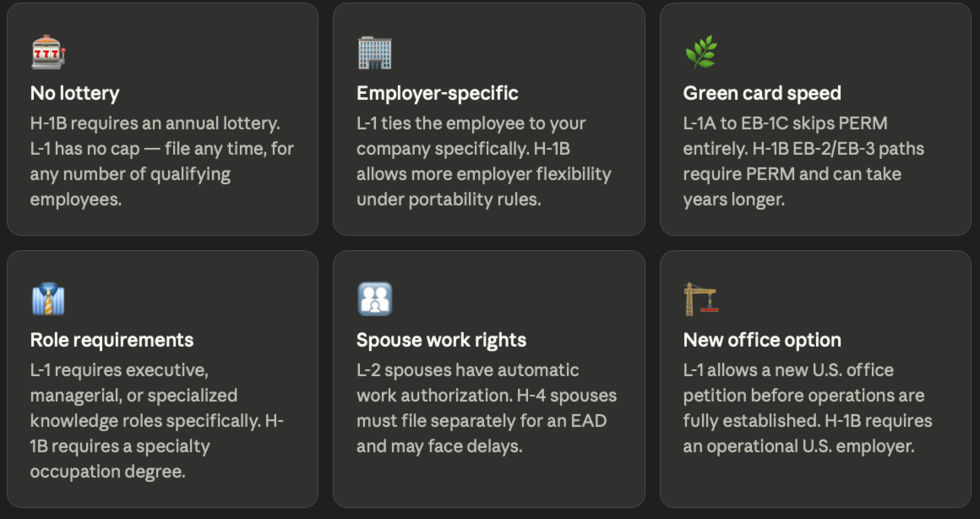
"For a multinational company bringing its leadership into the U.S., the L-1 visa is almost always a better strategic fit than the H-1B — because it was designed exactly for that purpose. The H-1B lottery introduces risk that no corporate expansion plan should have to absorb."
Frequently asked questions — L-1 visa
- What is the L-1 visa and who qualifies for it?
- What is the difference between L-1A and L-1B?
- Can I use the L-1 visa to open a brand new U.S. office?
- How does the L-1A visa lead to a green card?
- Can my spouse work in the U.S. on an L-2 visa?
- What is the one-year qualifying employment requirement?
- What happens when an L-1 holder reaches the maximum stay limit?
- Is the L-1 visa better than the H-1B for transferring employees?
- What is a blanket L petition and does my company qualify?

Comments
There are no comments for this post. Be the first and Add your Comment below.
Leave a Comment