
U.S. Immigration News:
July 2026 — What You Need to Know
Six major developments in the last two weeks have reshaped the immigration landscape for millions of families across the country. Some of these changes protect you. Some of them demand your immediate attention. All of them matter.
The most important U.S. immigration developments as of July 4, 2026: (1) The Supreme Court upheld birthright citizenship 6-3, rejecting executive limits. (2) ICE arrested 10,000+ people in 5 days nationwide as enforcement surges. (3) Expedited removal expanded nationwide (D.C. Circuit, June 23). (4) A new $102 annual asylum fee applies to all pending I-589 cases. (5) A federal court blocked the travel ban processing pause for 39 countries, allowing green card and EAD applications to move forward. (6) USCIS's new Atlanta Asylum Office opens July 8, expanding interview capacity in the Southeast.
Immigration law has never moved slowly, but the last two weeks have been something different entirely — a rapid, overlapping wave of court decisions, enforcement surges, fee changes, and new office openings that has left millions of immigrant families trying to figure out what it all means for them, specifically, right now. Some of it is genuinely good news. Some of it is alarming. And some of it requires action on your part immediately, regardless of how long you've been navigating this system.
Here's every major development, explained plainly — without the jargon, without the spin, and with a clear focus on what each one means for real people.
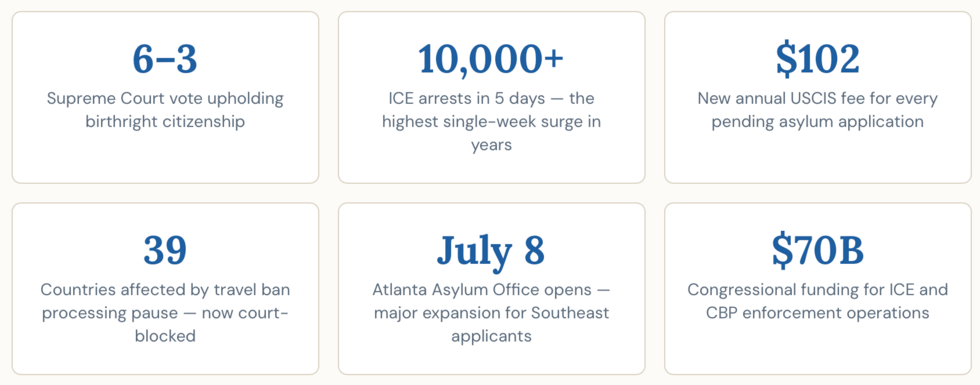
The Six Stories Shaping Immigration in July 2026
Story 1: Supreme Court Upholds Birthright Citizenship
In what immigration advocates are calling one of the most consequential constitutional rulings in a generation, the Supreme Court voted 6-3 to strike down the administration's executive order that would have limited birthright citizenship — the right of children born on U.S. soil to automatically be U.S. citizens, regardless of their parents' immigration status.
The Fourteenth Amendment has guaranteed birthright citizenship since 1868, and the Court's majority made clear that this protection cannot be undone by executive order. "Birthright citizenship is again what it has been since 1898 and what the Fourteenth Amendment has guaranteed since ratification," said AILA College of Past Presidents Member Jeremy McKinney in a statement following the ruling. The American Immigration Lawyers Association called the decision "a constitutional bulwark that has withstood another challenge."
For families who had been living with genuine fear that children born in the U.S. might lose their citizenship status, this ruling is a direct and unambiguous protection. It does not, however, resolve every other dimension of the administration's immigration enforcement agenda — which continues to intensify.
Story 2: ICE Arrests Surge to 10,000 in Five Days
Federal immigration officials conducted more than 10,000 arrests over a five-day period in late June and early July 2026, as the White House pushed for a target of at least 2,000 arrests per day — roughly double the pace of enforcement earlier this year, according to the New York Times. The surge is nationwide and not limited to any specific city, region, or target population beyond those without lawful immigration status.
Over 63,000 people are currently in ICE detention custody — a record high. The surge arrives alongside the nationwide expansion of expedited removal (covered below), creating a situation where apprehension is more likely and the consequences of being unprepared are more severe than at any point in recent memory.
This is not abstract. Enforcement is happening in neighborhoods, workplaces, and during routine daily activities nationwide. Community organizations and legal aid groups are reporting a sharp increase in calls from people who have witnessed or experienced ICE encounters.
Story 3: Expedited Removal Is Now Nationwide
As we covered in depth in our previous post, a 2-1 ruling by the U.S. Court of Appeals for the D.C. Circuit on June 23, 2026, cleared the way for ICE to apply fast-track deportation — known as expedited removal — anywhere in the United States, not just near the border. Previously, this process was largely limited to border areas and recent entrants.
Expedited removal allows immigration officers to deport certain individuals without a hearing before an immigration judge. If you do not have lawful status and cannot demonstrate continuous presence in the U.S. for at least two years, you are at risk under this policy. Critically, the court ruled that ICE is not required to tell you about the two-year protection — you must know it, assert it, and prove it yourself.
Story 4: New Annual Fee for Pending Asylum Applications
Beginning May 29, 2026, USCIS began imposing a recurring annual fee of $102 on all individuals with pending asylum applications under Form I-589 — for every year the case remains unresolved. This is in addition to the $100 filing fee that now applies to new asylum applications filed after July 22, 2025.
This is not a one-time payment. It will recur each year until the case is decided. And the consequences of missing the payment are severe: if the fee is not paid within 30 days of receiving notice, USCIS may reject the pending asylum application, deny or revoke related work authorization (EAD), and in some cases initiate removal proceedings against individuals without other lawful status.
Legal aid organizations have flagged a serious concern: some applicants are learning about these fees not from official USCIS notification but from checking the website or speaking with an attorney. When enforcement carries these kinds of consequences, communication gaps can cause people who are actively trying to comply with the law to inadvertently fall out of compliance.
Story 5: Court Blocks Travel Ban Processing Pause for 39 Countries
Since January 1, 2026, USCIS had been operating under a policy memorandum directing it to "hold and review" all pending immigration benefit applications — including green card applications and employment authorization documents — filed by nationals of the 39 countries on the updated travel ban list. For thousands of applicants, this created months of frozen cases and real-world consequences: applications sitting untouched, work authorization expiring, and lives on hold.
On June 5, 2026, a federal district court in Rhode Island blocked four USCIS policies implementing this hold, and a final judgment was issued on June 11. As of that date, immigration benefit applications — including green card cases and EADs — from nationals of the affected 39 countries may now move forward. USCIS published a news release on June 12 confirming it would follow the court order "pending possible further judicial review."
Note the key caveat: pending possible further judicial review. The government may appeal this ruling, which means the status of these cases could change again. If you or a family member has an application that was paused under this policy, working with an immigration attorney to actively monitor case status is essential.
Story 6: USCIS Opens New Atlanta Asylum Office — July 8
Beginning July 8, 2026, USCIS will open its new Atlanta Asylum Office, which will serve affirmative asylum applicants in Georgia and Alabama. This office will conduct interviews at three locations: a temporary Atlanta location, the USCIS Atlanta Field Office, and the USCIS Montgomery Field Office in Alabama.
For the Southeast's significant and growing asylum-seeking population, this is meaningful capacity expansion. Historically, asylum interview scheduling backlogs have stretched for years, and regional offices serve as crucial access points. The Atlanta office is expected to move to a permanent location in 2027.
If you have a pending affirmative asylum application in Georgia or Alabama, carefully review any interview notice you receive from USCIS — the location of your interview may change from what you previously expected, and appearing at the wrong location could create serious complications for your case.
In a Landscape This Volatile, What Should You Do Right Now?
Six major developments in two weeks. Some protect you. Some demand immediate attention. And more change is clearly coming — with further appeals, legislative fights, and enforcement initiatives all active simultaneously. In an environment this fast-moving, the most dangerous thing anyone can do is assume that what was true six months ago is still true today.
- Know your rights in an encounter. You have the right to remain silent. You have the right to an attorney. You do not have to let ICE into your home without a judicial warrant. If you fear persecution, clearly say so and request a credible fear interview.
- Gather and secure documentation of continuous U.S. presence. Tax returns, leases, bank statements, pay stubs, and medical records spanning the past two or more years are your legal protection against expedited removal — and they need to be accessible, not just somewhere in your home.
- If you have a pending I-589, monitor USCIS for fee notices. The 30-day payment window is tight and the consequences of missing it — including case rejection and loss of work authorization — are severe.
- If your application was paused under the travel ban, contact your attorney. The court order clearing those cases is real but potentially temporary if the government appeals. Do not assume your case is moving without confirmation.
- Make a family plan. If you have children, make sure a trusted person knows how to reach them if you are detained. Have a family preparation document that includes emergency contacts, your attorney's information, and copies of your key documents.
- Don't wait for an emergency to consult an attorney. The window between an ICE encounter and a removal order under expedited removal can be measured in hours. Legal guidance before that moment is the only meaningful protection.
Frequently Asked Questions
Did the Supreme Court uphold birthright citizenship in 2026?
Yes. On July 1, 2026, the Supreme Court ruled 6-3 in Trump v. Barbara to uphold birthright citizenship under the Fourteenth Amendment, rejecting the administration's executive order effort to limit it. Children born on U.S. soil remain U.S. citizens by birth regardless of their parents' immigration status, and this protection cannot be removed by executive action — it would require a constitutional amendment.
What is the new USCIS asylum annual fee and what happens if I miss it?
Beginning May 29, 2026, USCIS imposes a $102 annual fee on all pending asylum applications (Form I-589) for every year a case remains unresolved. New applications filed after July 22, 2025, also carry a $100 initial filing fee. If the annual fee is not paid within 30 days of notice, USCIS may reject the pending asylum case, deny or revoke related work authorization, and in some cases initiate removal proceedings. Monitoring your mail and email closely, and working with an immigration attorney to track these deadlines, is critical.
How does the ICE arrest surge in July 2026 affect me personally?
The surge — over 10,000 arrests in five days, with a White House target of 2,000 per day — is nationwide and untargeted at any specific city. If you or a family member lacks lawful immigration status, the risk of an ICE encounter has increased significantly. Coupled with the nationwide expansion of expedited removal, which can result in fast-track deportation without a hearing, the importance of being prepared — knowing your rights, having documentation of continuous presence, and having an immigration attorney's number ready — cannot be overstated.
Is my green card or EAD application moving again after the travel ban pause?
A federal court in Rhode Island blocked the USCIS "hold and review" policy that had frozen immigration benefit applications for nationals of 39 travel ban countries. The final judgment issued June 11, 2026, means those cases — including green card and employment authorization applications — may now move forward. However, the government may appeal, which could change things again. Contact your immigration attorney to get an active status update on your specific case rather than assuming it's progressing on its own.
Who does the new Atlanta Asylum Office serve?
The USCIS Atlanta Asylum Office, opening July 8, 2026, serves affirmative asylum applicants in Georgia and Alabama. Interviews will take place at three locations: a new temporary Atlanta office, the USCIS Atlanta Field Office, and the USCIS Montgomery Field Office in Alabama. Applicants in those states should watch for updated interview notices and verify their correct interview location before appearing, as previous scheduling may have changed.
Where can I find a trusted immigration attorney to help with these changes?
Malik Law PLLC provides experienced, client-centered immigration representation across a full range of immigration matters — from asylum and deportation defense to family-based green cards, employment visas, and business immigration. Contact us at (206) 771-6207, email [email protected], or visit maliklawpllc.com to schedule a consultation. Given how rapidly the law is changing right now, early consultation is far better than waiting for an emergency.
Immigration Law Is Moving Faster Than Most People Can Track.
We track it every day so you don't have to. Whether you need help understanding how this week's changes affect your specific case, or you're facing an urgent situation, the team at Malik Law PLLC is ready to help.


Comments
There are no comments for this post. Be the first and Add your Comment below.
Leave a Comment